What just happened in your garage
If you were home, you heard it. People describe it as a gunshot, a firecracker or something heavy falling off a shelf. If you weren't, you found out when you pressed the remote and the door rose a hand's width, shuddered and stopped.
Here's what's going on. Your garage door is heavy — a typical insulated two-car door is around 200 pounds. You don't feel that weight because one or two tightly wound steel springs are carrying it. When a spring breaks, the counterbalance disappears and the full weight of the door lands on the opener, which was never built to lift it alone. Most openers sense the overload and stop. That's a safety feature doing its job.
The spring didn't break because of anything you did. Springs flex every time the door moves, and steel can only flex so many times. After several thousand cycles a small crack forms, usually on a cold day, and the coil snaps.
How to confirm it's the spring
You don't need tools for this. Just look.
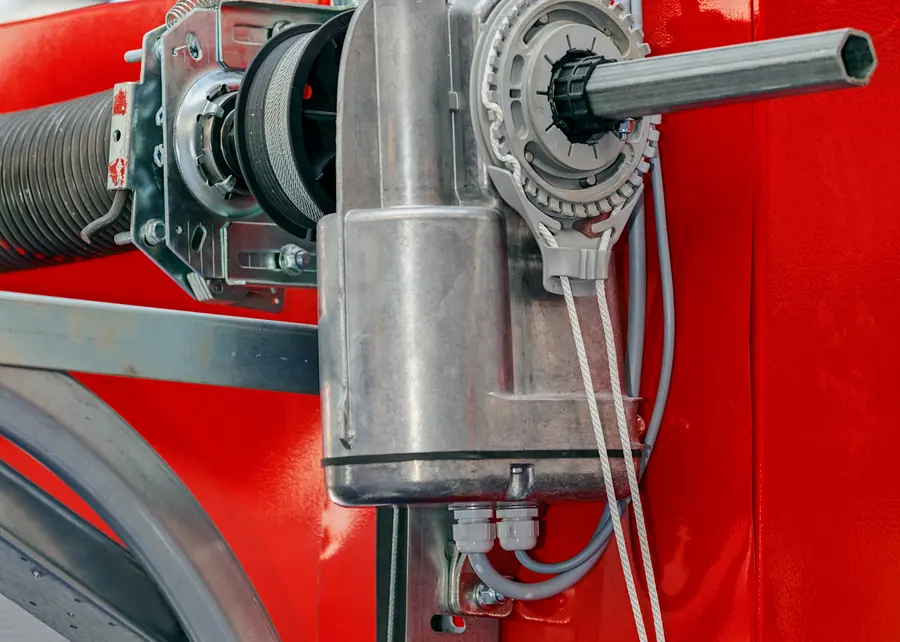
- Torsion spring: it sits on a steel shaft above the door. A broken one shows a clear gap of an inch or two somewhere along the coil.
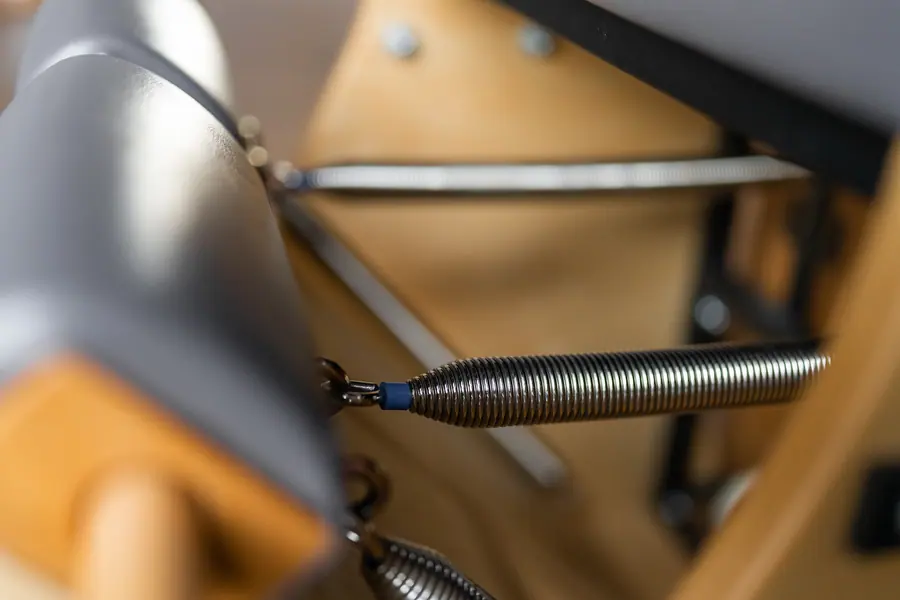
- Extension springs: they run along the horizontal track on each side. A broken one hangs limp, often with a piece dangling from the safety cable.
- Cables: the lift cables at each side of the door may be loose or off their drums, because nothing is holding them taut.
- The door: it feels impossibly heavy if you try to lift it by hand, or it's crooked because one of two springs has gone.
- The top section: sometimes bent or creased where the opener tried to pull against the dead weight.
What to do — and not do — right now
- Stop using the openerEvery attempt strains the motor, the drive gear and the top panel of the door. Unplug it if someone else in the house might press the button.
- Leave the door closed if it's closedA closed door with a broken spring is stable and secure.
- Don't pull the red release cord with the door openWithout a spring the door can come down with its full weight. If it's stuck partway up, keep people and pets clear and prop nothing under it yourself.
- Don't try to lift it aloneIf the car absolutely has to come out, tell us when you call. With two people and the right technique we can get it open safely.
- Don't loosen any hardwareThe remaining spring, if there is one, and the cables are still under tension.
- Call usTell us the door size and whether it's one spring or two above the door. It helps us arrive with the right stock.
How we carry out the repair
Spring replacement isn't complicated when you have the training and the right tools, but every step has to be done in order.
- Secure the door
- The door is clamped to the track so it can't move while we work.
- Release remaining tension
- Any intact spring is unwound with steel winding bars. This is the dangerous step, and it's never done with improvised tools.
- Remove the old springs
- The shaft is slid over, old springs and often the center bearing come off.
- Measure and match
- We measure wire diameter, inside diameter and length of the old spring and, importantly, weigh the door. Previous springs were not always right.
- Install the new springs
- Left- and right-wound springs go on in the correct orientation, with a new center bearing if the old one is worn.
- Check cables and drums
- Cables are inspected for fraying and reseated in the drum grooves. Worn ones are replaced.
- Wind and set
- The springs are wound to the turn count for the door height, then fine-tuned.
- Balance test
- With the opener disconnected, the door should lift easily and stay at knee, waist and shoulder height.
- Lubricate and reconnect
- Springs are lubricated, the opener is reconnected, and force, travel and safety reverse are tested.
Most broken-spring calls are finished in a single visit.
Choosing the replacement spring
You have more say in this than you might think.
Standard or high-cycle
A standard residential spring is typically rated for about 10,000 cycles. At four cycles a day that's roughly seven years. High-cycle springs, rated for 25,000 cycles or more, use heavier wire in a longer coil. They cost somewhat more and last a great deal longer. If your garage door is your front door — and for most families it is — the upgrade is worth considering.
Oil-tempered or galvanized
Oil-tempered springs are the dark, slightly oily ones. They're strong and hold their tension well. Galvanized springs resist rust better, which matters in damp garages and near the lakes, though they can need a small adjustment after settling in. We'll suggest one or the other based on your garage.
One spring or two
Lighter single doors often run on one spring. On heavier doors, two springs share the load and give you a margin: if one breaks, the other keeps some control over the door. Where a wide door was installed with a single spring to save money, we'll usually suggest converting to a pair.
Why springs fail early
Ten thousand cycles is the design life, but plenty of springs don't get there.
- Rust. Corrosion pits the wire and creates the weak point where a crack begins. Unlubricated springs in a humid garage go first.
- Wrong size. A spring that's too light for the door is overstressed on every cycle.
- Cold. Steel is less ductile at low temperatures. A worn spring is most likely to snap on the coldest morning of the winter.
- Heavy use. More cycles a day simply uses up the life faster.
- Added weight. Insulation kits, new windows or a water-logged wood door add pounds the original spring wasn't sized for.
 BEFOREAFTER
Before & after
A rusted, fatigued spring replaced with a clean new one
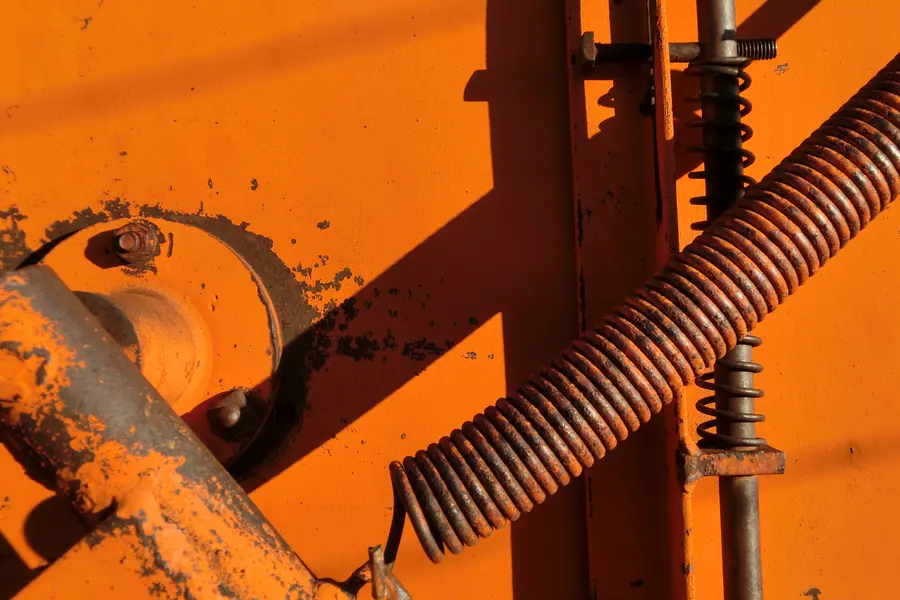
The "before" image shows a coil spring and its mounting hardware deep in rust. The steel is pitted, the surface is flaking, and the coils have lost their even spacing. A spring in this condition is living on borrowed time. Corrosion roughens the wire, friction between coils increases, and each cycle concentrates stress at the pits until one of them cracks through.
The repair illustrated is a straightforward spring replacement: the corroded spring is released and removed, a new spring of the correct wire size and length is installed with clean end fittings, and the door is rebalanced.
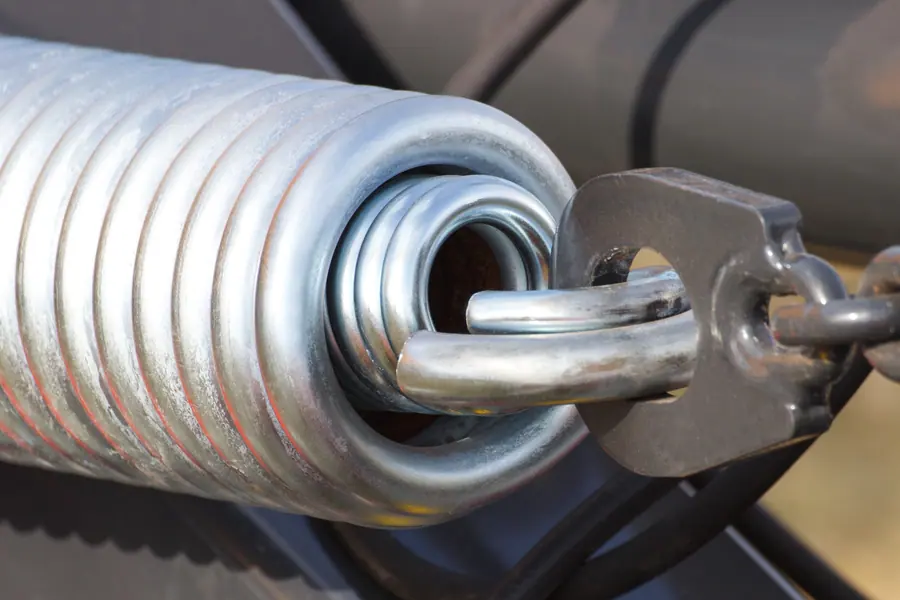
The "after" image shows the result at the part level — bright, uniform coils and a properly seated end hook with no slack. On the door, the change is immediate. It lifts with one hand again, stays where you leave it, and the opener goes back to guiding the door instead of dragging it. A lubricated, correctly sized spring will also run quieter and last years longer than the one it replaced.
Illustrative exampleThese two photographs are licensed reference images chosen to show the kind of change this service makes. They are not a record of one specific Delafield Garage Door job.
Spring season in Delafield
We could almost predict broken-spring calls from the weather forecast. The first night that drops well below zero, the phone starts early. It happens every year, and there's a reason.
Cold steel is more brittle. A spring that had a few hundred cycles left in mild weather reaches its limit sooner when the garage is ten or twenty below. At the same time, cold stiffens the lubricant on every moving part, the door takes more effort to move, and the bottom seal may be stuck to the floor. All that extra load passes through the spring.
Unheated garages and lake-area homes see it most. Moisture from snowmelt and damp air speeds up rust through the winter, and the cold finishes the job.
You can stack the odds in your favor. Have the springs lubricated in the fall. If they're approaching eight or ten years old, think about replacing them on your own schedule. And keep the threshold clear of ice so the door isn't fighting to break free.
Please don't attempt this one yourself
We say this as people who are generally in favor of homeowners doing their own maintenance. Garage door springs are the exception.
A wound torsion spring holds enough energy to lift a 200-pound door seven feet. Releasing that energy by accident — a slipped bar, a stripped set screw, the wrong bolt — can break a wrist, a jaw or worse in an instant. Emergency rooms see these injuries every year.
Even done safely, there's the matter of the right part. Springs aren't interchangeable. A spring that's 2 inches too short or one wire size off will leave the door unbalanced, and you'll be back where you started with a struggling opener.
Broken spring questions
Can I open my garage door with a broken spring?
It's possible but not advisable. The door is at its full weight and can drop without warning. If you must get a vehicle out, call us first and we'll help you do it safely or come and do it for you.
Should I replace both springs if only one broke?
Yes. Both have the same number of cycles on them. Replacing the pair keeps the door balanced and avoids a second failure shortly after the first.
How long does a spring replacement take?
Usually around an hour for a standard residential door, including the balance and safety checks.
How long will the new springs last?
Standard springs are rated for roughly 10,000 cycles; high-cycle springs for 25,000 or more. How many years that is depends on how often you use the door.
Why did my spring break when it was so cold?
Low temperatures make steel less flexible, and an aging spring is most likely to fail under those conditions. It's the most common time of year for it.
My opener still tries to lift the door. Is the opener broken too?
Probably not. It's stopping because it senses too much weight. Once the spring is replaced and the door balanced, most openers work normally. We test it before we leave.