Roll-up doors versus rolling steel doors
The names sound alike and people use them interchangeably, so it's worth separating them.
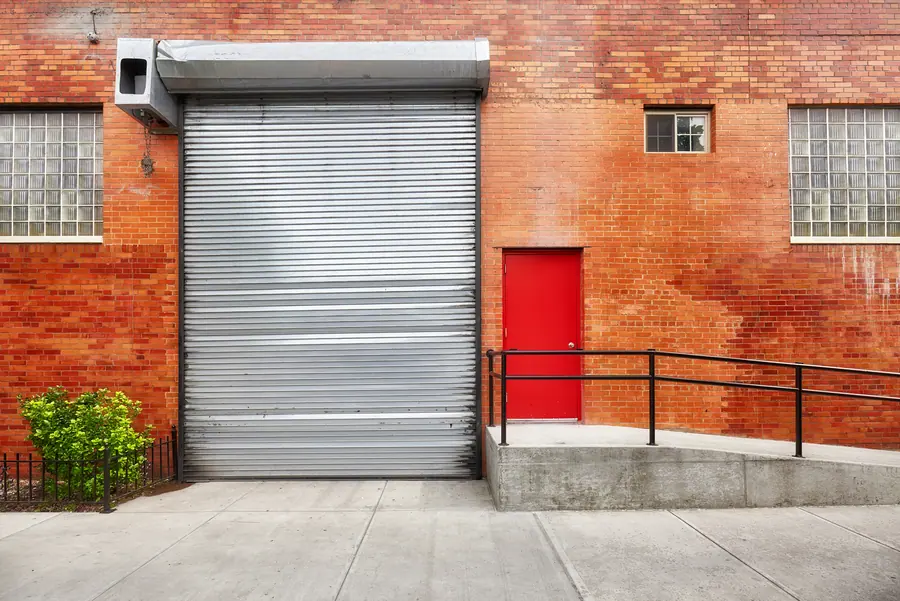
A rolling steel door is a heavy-duty curtain of individual interlocking slats, built for industrial openings.
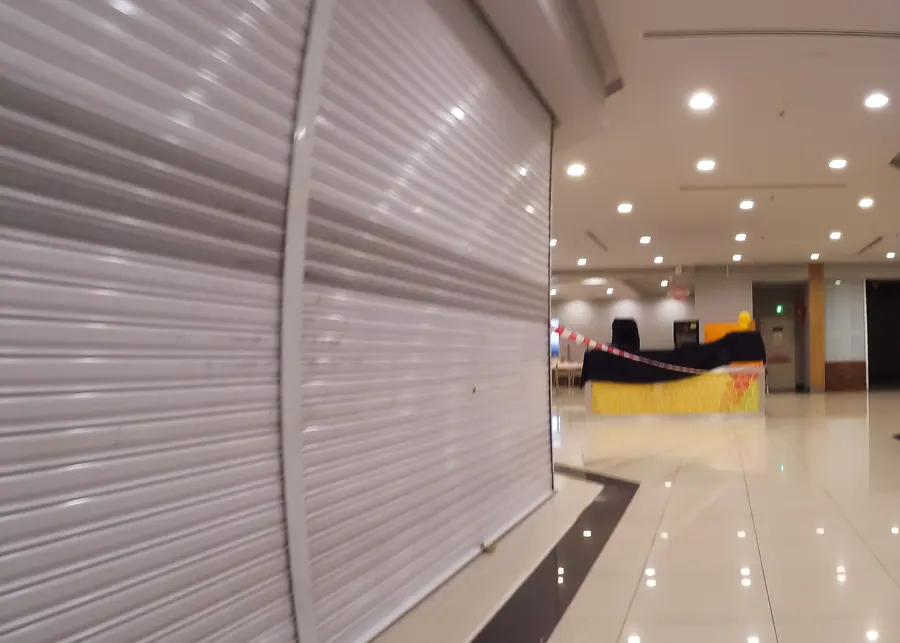
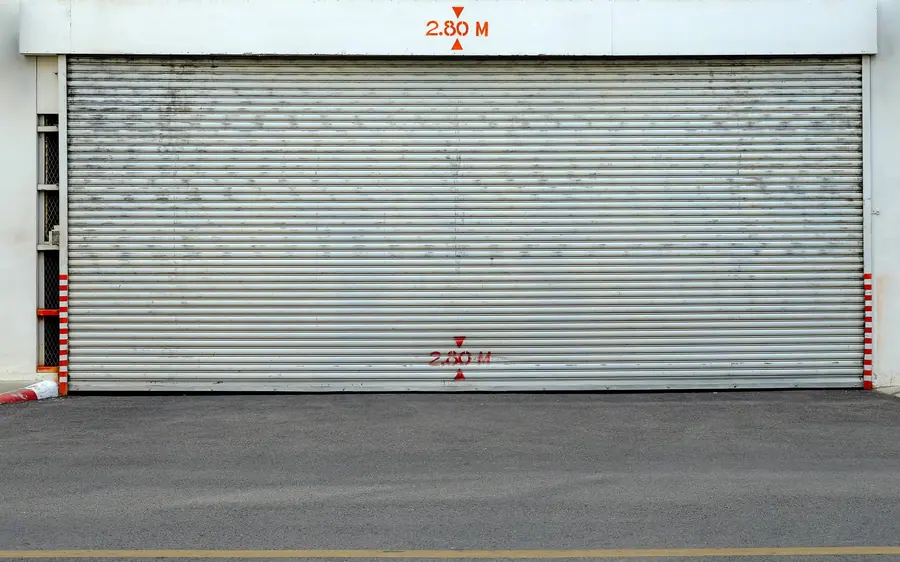
A roll-up sheet door is lighter. Its curtain is made of thin corrugated steel sheets, seamed together and wrapped around a drum-and-axle assembly at the top. There are no separate slats. The whole curtain rolls up like a window blind into a coil above the opening.
Sheet doors are quick to install, inexpensive and need little headroom. They're the door you lift by hand at a self-storage unit, and you'll also find them on mini-warehouses, garden sheds, small shop bays, agricultural buildings, concession stands and the back doors of retail units.
This page is about those lighter doors.
How a sheet door is put together
- Curtain
- Corrugated steel sheet, typically 26-gauge, with a baked-on color finish. Felt or plastic wear strips at the edges reduce friction and noise.
- Drums and axle
- Steel drum wheels on a tubular axle. The curtain attaches to the drums and wraps around them.
- Springs
- One or two torsion springs on the axle, usually enclosed, counterbalance the curtain.
- Tensioner
- A ratchet or bracket at one end that lets spring tension be added or released.
- Guides
- Light steel channels at each side.
- Bottom bar
- An aluminum or steel angle with a rubber or vinyl seal, a lift handle and often a step plate.
- Latch
- A slide latch on the curtain that engages the guide and takes a padlock or cylinder lock.
- Brackets
- Mount the axle to the wall or header.
- Operation
- Hand lift with a pull rope, a chain hoist reduction, or a small electric operator.
What goes wrong with them
Sheet doors are forgiving, but they have a few characteristic ailments.
- Heavy to lift, or won't stay up. The springs have relaxed over time. This is by far the most common complaint.
- Shoots up or won't stay down. Too much tension, sometimes after a well-meant adjustment.
- Curtain rubbing or binding in the guides. Guides out of plumb, bent, or packed with dirt.
- Curtain kinked or creased. Forced against a jam, hit by a vehicle, or closed on something.
- Curtain coiling crooked. One side wraps tighter than the other, so the bottom bar sits at an angle.
- Latch won't engage. The curtain has shifted, the guide slot is bent, or the latch is rusted.
- Bottom seal torn or missing.
- Broken spring. The door becomes dead weight.
- Faded, peeling or rusted curtain.
- Noisy operation. Dry wear strips, loose brackets, or the curtain slapping the guides.
- Damaged brackets. From impacts or from the door being overloaded.
How we fix them
The usual cure for a heavy door. Tension is added at the tensioner in measured steps until the door balances at mid-height.
When a spring has broken or the axle assembly is damaged, the unit is replaced.
Guides are cleaned, straightened and set plumb with the right clearance. Bent sections are replaced.
Minor dents can be dressed. Badly creased curtains are replaced, as a kink in corrugated sheet rarely rolls smoothly again.
Straightened or replaced, with a new seal.
Freed, realigned or replaced. See also lock repair.
New felt or polymer strips reduce noise and curtain wear.
For motorized doors, limits, drive and controls are checked.
The repair process
- Assess the door and its useSize, age, how often it runs, manual or powered.
- Secure itA sheet door with a broken spring will drop. It's supported before work begins.
- Check balanceLifted by hand to feel the weight through its travel.
- Inspect the curtain and guidesFor creases, wear, rubbing and alignment.
- Inspect the axle, springs and bracketsTension, condition and fixings.
- Make the repairTension adjusted or components replaced.
- LubricateSprings and bearings; guides are cleaned and given a light dry lubricant.
- TestThe door should lift with modest effort, stay where it's left and latch cleanly.
On a storage site or a building with many identical doors, we'll work through them in sequence. It's efficient, and it means every door gets the same attention.
A word about tension adjustment
Adding tension to a sheet door looks easy: there's a ratchet or a bracket, and a few clicks make the door lighter. That's exactly why it goes wrong.
Too little tension and the door is heavy. Too much and it won't stay closed, slams open, or over-stresses the spring and shortens its life. Uneven tension between two springs makes the curtain roll crooked. And the tensioner is holding back real force — if it slips while someone's hand is on it, injuries follow.
We adjust in small increments and test the balance after each, with the door properly supported.
Self-storage and multi-door sites
Storage facilities have their own rhythm. Dozens or hundreds of identical doors, each opened by members of the public who aren't gentle with them. Units stand closed for months, then get opened by someone who yanks the door when it sticks.
For those sites, planned maintenance makes far more sense than waiting for complaints. A periodic pass through the facility — tension, guides, latches, seals — keeps doors easy to use and reduces damage caused by tenants forcing a stiff door. We can also replace doors unit by unit as they reach the end of their life, matched to the existing color.
Is a sheet door worth repairing?
Sheet doors are among the least expensive commercial doors, so the calculation is different from a sectional or rolling steel door.
Repair is sensible for tension problems, guide alignment, latches, seals and bottom bars. Replacement is usually better when the curtain is badly kinked, rusted through or peeling beyond a tidy repaint, or when the spring and axle have failed on an old door. A new door installs quickly and often costs little more than an extensive repair.
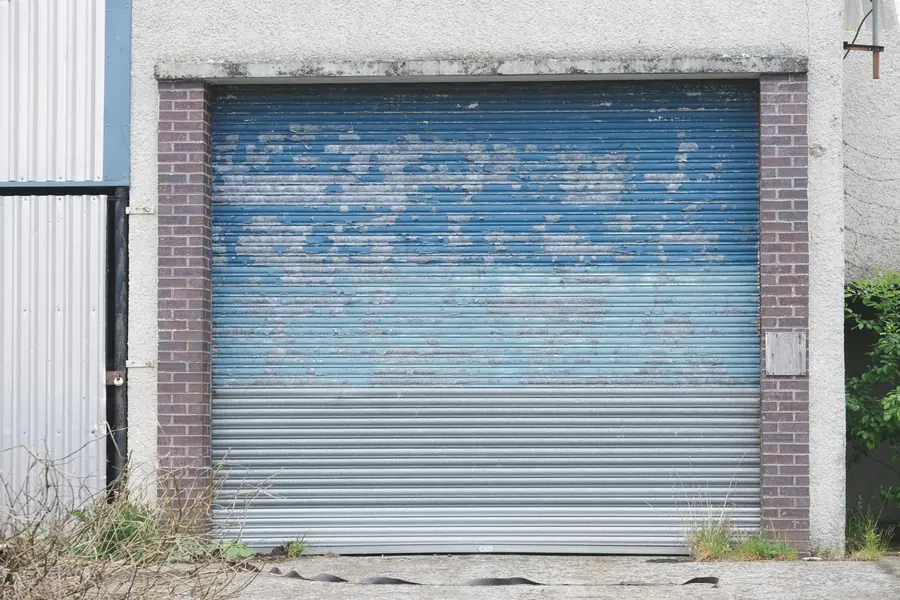
 BEFOREAFTER
Before & after
A faded, peeling roll-up door compared with clean, straight roll-up doors
The "before" image shows a faded blue roll-up door with its paint peeling away in patches. The curtain has weathered unevenly, there's rust beginning where the finish has failed, and vegetation is creeping in at the base. A door in this condition usually runs as poorly as it looks: stiff, noisy, and reluctant to latch.
The work illustrated is the restoration of roll-up doors to good working order — in cases like this by replacing the tired curtain with a new one, resetting the spring tension, aligning the guides and fitting a new bottom seal.
The "after" image shows a row of clean blue doors with straight, even corrugations and consistent lines along the bottom. They sit squarely in their guides. For an owner, that means doors that lift with one hand, stay up without help, close and latch properly, and give the building a cared-for look that tenants and customers notice.
Illustrative exampleThese two photographs are licensed reference images chosen to show the kind of change this service makes. They are not a record of one specific Delafield Garage Door job.
Roll-up doors in Wisconsin weather
Sheet doors are usually installed to unheated buildings, so they live in whatever the weather provides.
Frozen bottom seals. Meltwater pools at the sill and freezes the seal down. People pull hard on the handle or rope, and the bottom bar bends or the curtain kinks. Good drainage at the threshold and a clear sill prevent it.
Ice in the guides. Water runs down the curtain and freezes in the channels. The door jams partway.
Salt. Sites that are plowed and salted see corrosion on bottom bars, guides and the lower curtain.
Wind. A light curtain flexes in strong gusts and can pull out of shallow guides. Wind-rated doors and guides with deeper engagement are available for exposed sites.
Cold and spring tension. Stiff lubricant and contracted steel make a marginally balanced door feel heavy in January. A door that's correctly tensioned copes fine.
Snow load and drifting. Drifts against a door add weight to the bottom bar and pack the guides. Clearing them before opening avoids damage.
Dust on farms. Chaff and grit in the guides wear the curtain edges. A seasonal clean-out pays off.
Sun and fading. South- and west-facing doors fade and chalk first. Quality finishes last much longer than budget ones.
Why call a professional
A sheet door is light enough that owners are tempted to handle everything themselves. For cleaning guides and lubricating, by all means.
Tension adjustment and spring replacement are different. The spring is under load, the tensioner can slip, and the door can fall if it isn't supported. Getting the balance right also takes a feel for it.
We bring matching parts for the common makes, the right method for each tensioner design, and the experience to tell a door that needs ten minutes of adjustment from one that's due for replacement.
Roll-up door questions
Why is my roll-up door so heavy?
The spring has lost tension. It can usually be restored with an adjustment at the tensioner.
Can a creased roll-up curtain be repaired?
Small dents sometimes can. A sharp crease across the corrugations generally means the curtain should be replaced.
How often should roll-up doors be serviced?
Yearly for most; more frequently on busy storage sites or where doors face heavy weather.
Can you service a whole storage facility?
Yes. We can work through every door on a site and set up a recurring schedule.
Can a manual roll-up door be motorized?
Many can be installed with a small operator, along with the appropriate safety devices.
What's the difference between a roll-up door and a rolling steel door?
A roll-up door has a light corrugated sheet curtain. A rolling steel door has a heavy curtain of interlocking slats and is built for industrial duty.