First, the safety part
If you're reading this with a garage door hanging at an angle, here's what matters right now.
- StopDon't press the remote or the wall button again. The opener will only pull the door further out of line.
- Keep everyone awayA door out of its track isn't supported the way it should be. Keep children, pets and cars clear of it and of the area underneath.
- Unplug the openerThis prevents anyone triggering it by accident, including a timer or a phone app.
- Don't pull the emergency release if the door is partly openReleasing the trolley removes the one thing that may be holding the door up.
- Don't try to push it backThe door weighs a couple of hundred pounds and the cables and springs are still loaded. Forcing a roller back in can bend the track further or bring the door down.
- If it's closed or nearly closed, leave it thereThat's its most stable position.
- Get in touchTell us whether the door is up, down or partway, and which side is out. Photos help.
What "off track" actually means
Your door is guided by rollers running inside steel channels at each side. "Off track" means one or more of those rollers has come out of its channel. Sometimes it's a single roller at the top. Sometimes an entire side is out and the door is wedged diagonally across the opening.
When that happens the door loses its guidance on that side. It can twist, drop at one corner, or jam hard against the opposite track. The lift cables often go slack and unwind from their drums, which adds another problem to the first.
Why doors come off
There's always a reason, and fixing only the symptom means it will happen again.
A car bumper, a trailer, a ladder. The track bends, the gap opens and a roller escapes.
A trash can, a bike or a broom handle stops one side while the other keeps moving. The door racks and pops out.
With one side unsupported, the door drops on that side and drags its rollers out.
The door lurches under its full weight.
A roller with a failed bearing or a bent stem wanders out at the curve.
Tracks that are too far apart, out of plumb or loose at the brackets leave the rollers barely captured.
The hinge holding a roller cracks or pulls free of the section.
The opener heaves against a door stuck to the floor, something gives unevenly, and a side jumps.
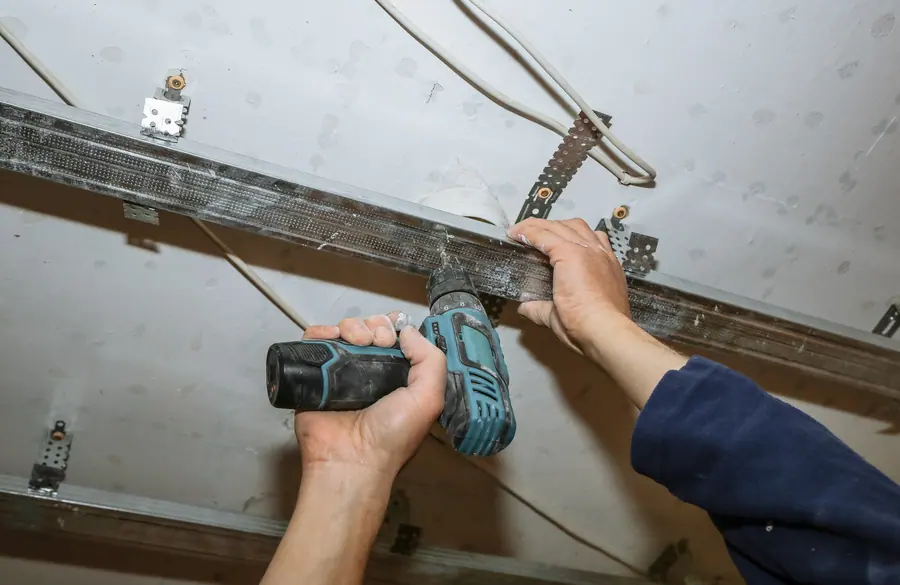
How we put it right
Every off-track door is a little different, but the method is consistent.
- Stabilize
- Before anything else, the door is supported and clamped so it can't shift while we work.
- Assess
- Which rollers are out, what's bent, where the cables are, whether a spring has failed, and whether any sections are damaged.
- Relieve tension where needed
- If cables are tangled or the door has to be lowered, spring tension is released under control.
- Open the track
- Rather than forcing rollers back through the channel, the track is loosened or opened at the right point to let them re-enter.
- Reseat the rollers
- Each one is guided back in. Bent stems and worn wheels are replaced.
- Repair the track
- Bends are straightened where the steel is sound; creased or torn pieces are replaced.
- Reset cables and drums
- Cables are rewound in their grooves with equal tension side to side.
- Realign
- Vertical tracks plumbed, horizontals leveled and squared, all brackets tightened into framing.
- Fix the cause
- The broken cable, worn roller, loose bracket or failed hinge that started it is dealt with.
- Rebalance and test
- The door is balanced by hand, then run under power with the force and safety reverse checked.
Many off-track doors can be made right in one visit. If a section has been creased or a matching panel is needed, we'll secure the door so the garage can be closed and return when parts arrive.
Collateral damage to check for
A door doesn't leave its track gently. We look for knock-on damage so nothing is missed.
- Sections: creases along the hinge line or at the edges where the door jammed
- Hinges: bent leaves and cracked knuckles near the point of derailment
- Rollers: bent stems, chipped wheels
- Cables: kinks where they came off the drum, which weaken the cable permanently
- Bottom brackets: twisted when a corner dropped
- Top section: buckled if the opener kept pulling
- Opener: a bent rail, a damaged trolley or a stripped drive gear
- Track brackets and hangers: pulled or loosened by the door's weight shifting
You'll get a clear list of what's affected and what each item involves.
Stopping it happening again
Most off-track incidents are preventable. Once the door is back, a few things lower the odds considerably.
- Keep the photo-eyes working and aligned. They stop the door closing on a car or an object.
- Never leave things in the door's path. Trash cans and bikes parked on the threshold are the usual suspects.
- Replace worn rollers and cables before they fail. Both are inexpensive and both are leading causes.
- Have loose track brackets tightened. A yearly check catches them.
- Don't run the opener against a stuck door. Free it first.
- Keep the door balanced. A balanced door moves under control; an unbalanced one lurches.
Can it wait?
If the door is down and the garage is secure, a short wait does no harm. Just don't use it.
If the door is stuck open, it's more pressing. The garage is exposed to weather and to anyone walking by, and in winter an attached garage will lose heat quickly. A door hanging partly open is also the least stable position. Let us know the situation and we'll prioritize accordingly.
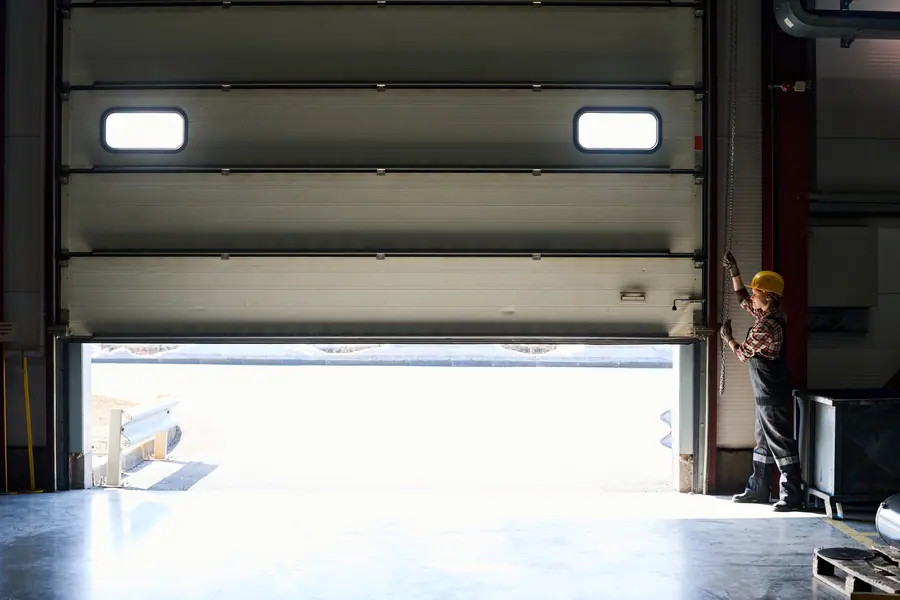
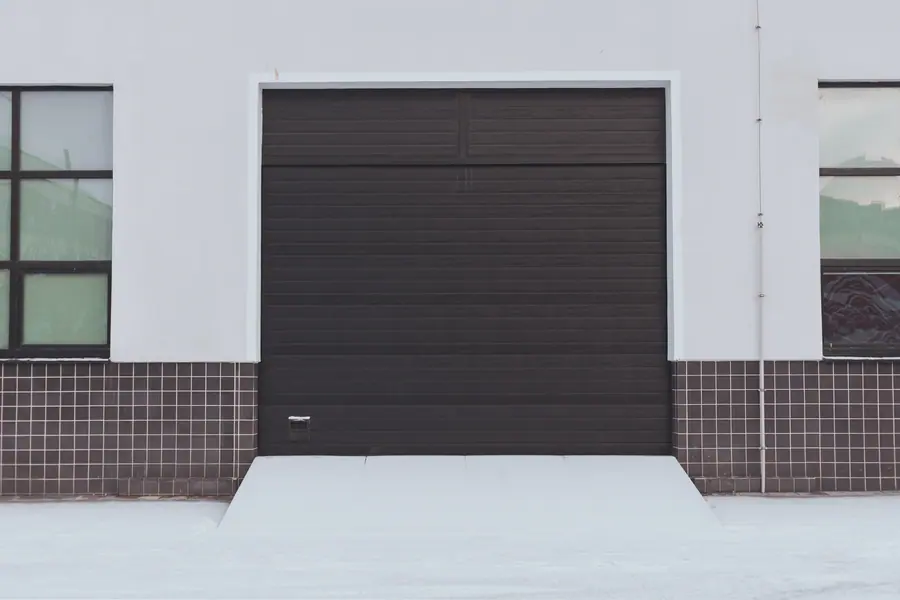 BEFOREAFTER
Before & after
A door stuck open compared with a door closed flush and secure
The "before" image shows an overhead door stopped in the raised position with the bay open to the outdoors behind it. This is the practical reality of an off-track door stuck up: it can't be closed, the interior is exposed to wind and snow, and the building can't be secured. The door itself is hanging on whatever rollers are still engaged.
The repair illustrated is a full off-track recovery. The door is supported, the rollers are fed back into their channels, bent track is straightened or replaced, the cables are rewound evenly, and the cause — in cases like this often a slipped cable or a worn roller — is corrected.
The "after" image shows a dark sectional door closed neatly within its opening, meeting the floor along its full width. The lines are straight and the margins even at both jambs. That's what the owner gets back: a door that travels in its tracks, closes completely, and can be locked and left with confidence.
Illustrative exampleThese two photographs are licensed reference images chosen to show the kind of change this service makes. They are not a record of one specific Delafield Garage Door job.
Off-track doors and Wisconsin winters
Winter gives us more of these calls than any other season, and three local conditions are behind most of them.
Frozen thresholds. Meltwater pools under the door and freezes it to the slab. The opener starts, one side breaks free before the other, and the door twists in the opening. Sometimes a roller pops; sometimes a cable goes slack and jumps the drum.
Ice in the tracks. Water runs down the inside of the door, collects in the bottom of the vertical track and freezes. The lower rollers ride up over the ice and out of the channel.
Dark mornings and tight garages. Bumped tracks are a winter speciality. Snow-narrowed driveways, frosted windows and a rush to get going are a reliable recipe for a mirror or bumper catching the track.
Cold also stiffens every moving part, so a door that was marginal in October — a slightly worn roller, a bracket a bit loose — tips over the edge in January.
The simple preventive steps are the ones that matter: keep the threshold and lower tracks free of ice, and if the door doesn't respond normally, look before you try again.
Why this isn't a DIY repair
It's tempting to grab the door and shove a roller back into the track. We understand. Please don't.
A garage door off its track is an unsupported weight held by components that are no longer in their intended positions. The springs and cables are still loaded. Moving the door can release that energy unpredictably, drop a corner, or pull the remaining rollers out.
Beyond the immediate hazard, there's the diagnosis. Getting the door back in is the easy half. Finding out why it came out — and correcting the track geometry so it doesn't happen again — is the half that takes experience.
Off-track questions
Is it safe to leave my garage door off its track overnight?
If it's fully closed and stable, yes. Don't operate it. If it's stuck open or hanging partway, call us so we can secure it.
Can I still open the door manually?
Please don't. Without proper guidance the door can twist, jam harder or fall.
Will I need a new door?
Usually not. Most off-track doors are repaired with new rollers, track adjustment and sometimes a cable or hinge. A new section or door is only needed if panels were badly creased.
How long does an off-track repair take?
Often one to two hours, depending on how far out the door is and what was damaged.
Why did my door come off the track when nothing hit it?
Worn rollers, a slipped or broken cable, loose track brackets or a door frozen to the floor can all cause it without any impact.
Can a bent track be reused?
If the bend is minor and the steel isn't creased, it can often be straightened. Sharply bent or torn track is replaced.