Why people still choose wood
Steel is practical. Composite is clever. Wood is the one people stop and look at.
Part of it is honesty of material. A stained cedar door has variation no printed finish reproduces: tight grain next to open grain, a slight shift in tone from board to board, the way it darkens over years. Part of it is weight. A wood door closes with a sound that tells you it's solid.
And part of it is context. So many of the best houses around Delafield are built of natural materials. Fieldstone foundations, cedar shakes, heavy timber porches, lannon stone walls. A wood garage door finishes that picture in a way nothing else does.
It does ask more of its owner. We'll be upfront about that below.
Choosing a species
- Western red cedar
- Light, stable and naturally resistant to decay. Takes stain beautifully in tones from honey to deep brown. The most popular choice for good reason.
- Hemlock
- A smooth, fine-grained softwood that's ideal for painted doors and takes a uniform stain. Slightly harder than cedar.
- Mahogany
- Dense, rich and dimensionally stable, with a deep red-brown color under a clear finish. A premium option for a showpiece door.
- Knotty alder
- Rustic character with visible knots. Suits lodge and timber-frame styles.
- Douglas fir
- Strong, straight-grained and traditional in craftsman work. Good painted or stained.
- Reclaimed timber
- Old barn boards and similar stock can be used as a face material over a stable core, where the supply and condition allow.
How wood doors are built
There are three broad approaches, and the right one depends on exposure, budget and how much weight the opening can carry.
The traditional method. A frame of solid stiles and rails holds floating panels that can expand and contract. Authentic, heavy and beautiful.
Boards or panels applied over an insulated steel or composite base. Lighter and warmer than solid wood, with better stability in our climate.
Tongue-and-groove boards laid vertically, horizontally or on the diagonal over a structural backing. The basis for most contemporary wood doors.
For most attached garages here we recommend the overlay approach. You see and touch real wood, the core does the insulating, and the door moves far less through the seasons.
Design options
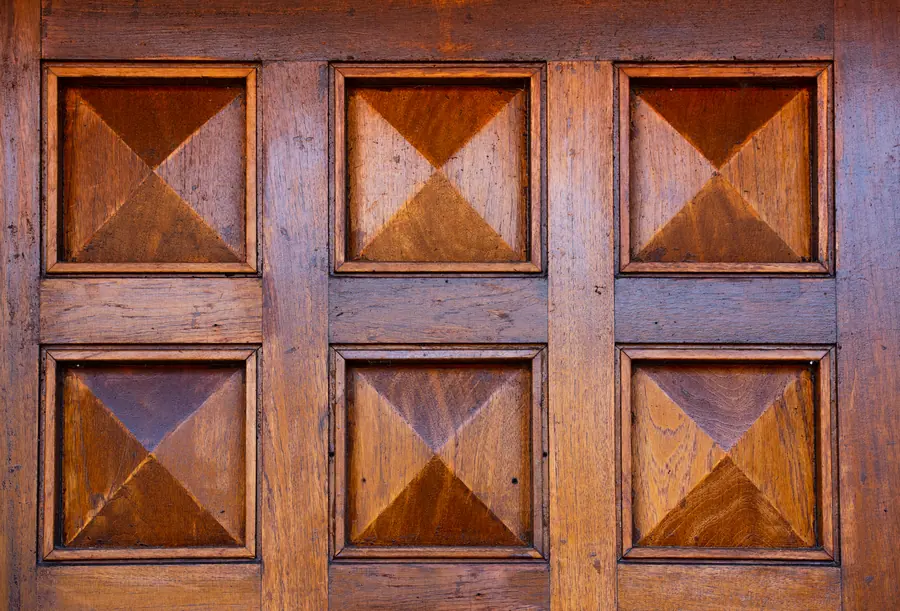
- Panel layout: raised, recessed, flat, V-groove, beadboard or plank
- Top profile: square, eyebrow arch or full arch built into the top section
- Glass: clear, seeded, leaded-look or frosted lites in the upper section
- Bracing and overlays: crossbuck, Z-brace or herringbone patterns
- Hardware: forged-style straps, ring pulls, clavos and escutcheons
- Finish: clear coat, semi-transparent stain, solid stain or paint
A good starting point is the front door. If the entry is stained oak or mahogany, a garage door in a related tone ties the facade together. If the trim is painted, a painted wood door in the same color with stained accents can work well.
The finish is the door's armor
Everything about a wood door's lifespan comes back to keeping water out of it.
A proper finish covers all six sides of every section: face, back, both ends, top and bottom edge. The bottom edge of the lowest section matters most, because that's where water sits and wicks upward. Skipping it is the most common reason wood doors fail early.
Stains and clear finishes with UV inhibitors protect against sun, which breaks down the surface fibers and turns unprotected wood gray. Semi-transparent stains show the grain and need recoating more often. Solid stains and paints last longer between coats.
How often? It depends almost entirely on exposure. A north-facing door under a deep overhang may go several years. A south- or west-facing door in full sun might want a maintenance coat every year or two. The test is simple: sprinkle water on it. If it beads, you're fine. If it soaks in and darkens, it's time.
How a wood door project runs
- Visit and discussionWe look at the house, the exposure and the opening, and talk through what you have in mind.
- MeasureCarefully, twice. Wood doors are built to the numbers.
- DesignSpecies, construction, layout, glass and hardware, with shop drawings for approval.
- BuildThe door is made to order. Timeframes vary with the maker and the complexity.
- FinishFactory-finished, or sealed on all sides before hanging and completed on site.
- InstallHeavy-duty track, springs calculated for the real weight, reinforced hinges and a suitably rated opener.
- HandoverWe explain the finish schedule and what to watch for through the first year.
Problems we see on older wood doors
We repair a lot of wood doors, and the causes are remarkably consistent.
- Rot along the bottom rail where the edge was never sealed
- Joints opened up by repeated wetting and freezing
- Panels split because they were glued or painted in and couldn't move
- Finish peeled on the weather side while the sheltered side looks new
- Sagging across a wide door built without enough internal reinforcement
- Springs and opener undersized for a door that got heavier as it absorbed moisture
Many of these can be repaired if they're caught in time: a new bottom rail, re-glued joints, a strip and refinish. If you have an older wood door you'd like to keep, ask us before assuming it's a write-off.
 BEFOREAFTER
Before & after
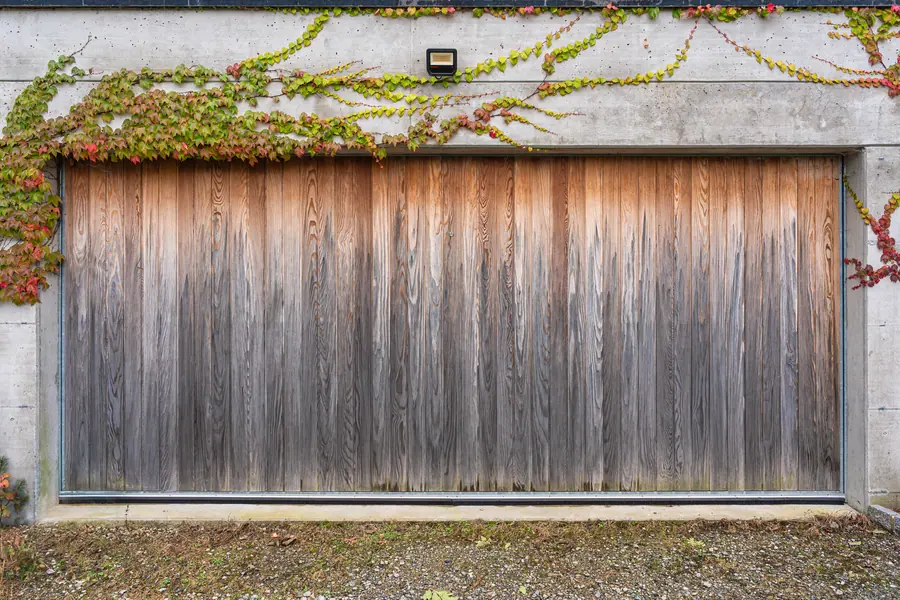
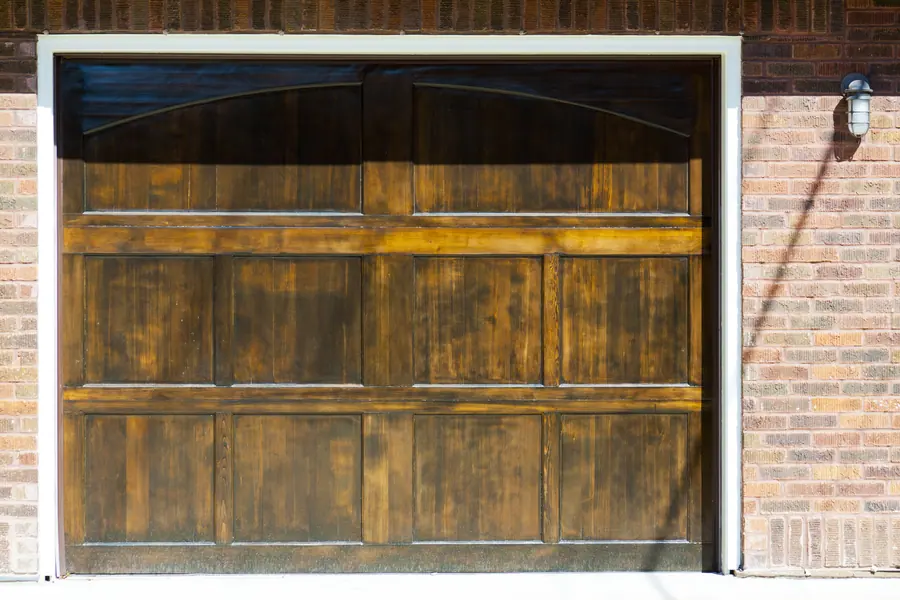
A sun-bleached wood door set against a newly finished raised-panel wood door
The "before" image shows a wood door that's been left to the weather. The boards have bleached to gray, the surface is dry and rough, and vines have begun to work across the wall above it. There's no finish left to speak of. Wood in this condition absorbs water freely, and the next stage is checking, cupping and eventually rot at the lower edge.
The service illustrated is a new custom wood door, built with raised panels and an arched top rail, then stained and sealed before installation. It replaces the old boards entirely, along with the track and springs behind them.
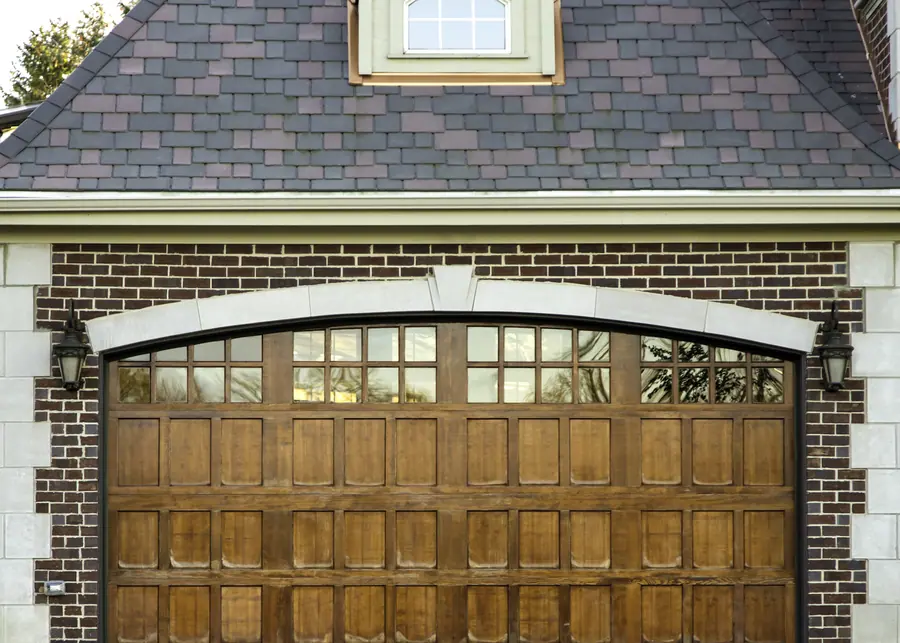
In the "after" image the timber is a deep, even brown with the grain clearly visible, and the panels cast crisp shadows. It sits neatly in its brick opening. For the owner, that means a door that sheds water, keeps its shape, runs smoothly on hardware rated for its weight, and gives the house the kind of warmth only real wood provides.
Illustrative exampleThese two photographs are licensed reference images chosen to show the kind of change this service makes. They are not a record of one specific Delafield Garage Door job.
Wood doors in a Wisconsin climate
This is the part to think hardest about. Wood and our weather can get along, but only with the right door in the right place.
Humid summers swell wood. Dry, cold winters shrink it. A door has to be built to allow that movement, with floating panels and flexible seals. Freeze-thaw is the real enemy: any water that gets into a joint expands when it freezes and levers the joint open a little more each time.
Snow piled against the bottom section is another risk. Keep the threshold shovelled and don't let a drift sit against the door for weeks.
Orientation and shelter make the biggest difference of all. A recessed opening, a pergola or a generous eave above the door will double the life of the finish. For an exposed wall with no protection, we'll often recommend a wood overlay on an insulated core, or a stain-grade composite, and tell you honestly why.
Lake properties add moisture in the air. There, we lean toward cedar or mahogany for their natural resistance, and stainless or coated hardware so nothing bleeds rust down the face.
Why heavy wood doors need an experienced installer
A solid wood double door can weigh several hundred pounds. That calls for heavier track, long-stem rollers, reinforced hinges and springs wound to match. Getting the spring calculation wrong on a door that heavy isn't just hard on the opener; it's a safety problem.
Design experience counts as well. Knowing how wide a door can be before it needs internal steel, which joints hold up outdoors, and which finishes survive a west-facing wall comes from doing it.
Wood door questions
How long does a wood garage door last?
With a maintained finish and reasonable shelter, decades. Neglected, a wood door can be in trouble inside ten years. The finish schedule decides it.
How often will I need to refinish it?
It depends on exposure. Sheltered doors may go three to five years between maintenance coats; doors in full sun and weather might need attention every year or two.
Are wood doors insulated?
Solid wood has modest natural insulating value. Overlay doors with a foam core perform much better and are what we suggest for attached garages.
Can you repair my existing wood door?
Often. Bottom rails, individual panels and failed finishes can usually be dealt with if the rest of the door is sound.
Is wood much heavier than steel?
Yes, noticeably. We size the springs, track and opener for the finished weight, and it's one reason existing hardware usually can't be reused.
What about a wood-look alternative?
Composite and wood-grain steel doors have become very convincing and need far less upkeep. If maintenance worries you, we'll show you both and you can compare them side by side.