Why a garage door needs looking after
Count the times your door opens and closes in a day. For a typical family it's four to six cycles; with teenagers or a home business it can be double that. Over a year that's somewhere between 1,500 and 3,000 trips up and down for a door weighing a couple of hundred pounds, guided by ten or twelve small rollers and counterbalanced by springs that flex with every cycle.
Nothing mechanical runs that hard without wear. Lubricant dries out. Fasteners loosen as the door flexes through the curve of the track. Springs gradually lose tension, so the door gets heavier and the opener works harder. Cables fray where they wrap the drum. None of it happens overnight, which is exactly why it goes unnoticed. The door that takes a second longer to open than it did last year, or sounds a little rougher on a cold morning, is a door asking for attention in the only way it can.
Maintenance is simply stopping to look. Done regularly, it turns surprise failures into planned, inexpensive part replacements.
What a maintenance visit includes
- Balance test
- With the opener disconnected, the door is lifted by hand to mid-height. A balanced door stays put. If it sinks or rises, the springs are adjusted.
- Spring inspection
- We look for gaps, corrosion, uneven coil spacing and signs of fatigue, and check the spring anchor and center bearing.
- Cables and drums
- Checked for fraying, rust, kinks and correct seating in the drum grooves.
- Rollers
- Each one is spun and wiggled. Worn bearings, flat spots and cracked nylon are noted.
- Hinges and brackets
- Inspected for cracks and elongated holes; every fastener on the door is checked for tightness.
- Track
- Alignment, spacing, plumb and level are verified; brackets are tightened; debris is cleaned out.
- Lubrication
- Springs, hinges, roller bearings and the opener rail are lubricated with a product suited to cold weather.
- Opener
- Drive tension, travel limits, force settings, the emergency release and the wall control are tested.
- Safety systems
- Photo-eyes are cleaned, aligned and tested. The contact reversal is tested with an object under the door.
- Seals
- Bottom seal and perimeter weatherstripping are checked for cracks, gaps and stiffness.
At the end you get a straightforward summary: what's fine, what we adjusted, and what's wearing and will want replacing in the next year or two. No drama, and no obligation to do any of it on the spot.
What we find most often
After enough maintenance visits you start to see patterns. On doors that haven't been serviced in several years, these turn up again and again:
- Springs that have never been lubricated and are rusting between the coils
- A door that's ten or twenty pounds out of balance, with an opener compensating
- Two or three rollers with failed bearings, usually the ones nearest the floor
- A center hinge cracked at the knuckle on a double door
- Lag screws backing out of the flag brackets that hold the track
- Photo-eyes held roughly in line by a bent bracket and good luck
- A bottom seal flattened and brittle, with daylight visible at the corners
Each of those is a small job on its own. Left alone, a failed roller wears the track, an unbalanced door kills the opener, and a cracked hinge lets a section fold.
What you can do between visits
We're glad when homeowners keep an eye on things. A few simple habits make a difference.
- Look and listen monthlyWatch the door run a full cycle. It should move evenly and without jerks. New noises are worth noting.
- Test the reverseLay a short length of 2x4 flat on the floor under the door and close it. The door should touch the board and reverse. If it doesn't, call us.
- Check the photo-eyesWave something through the beam while the door is closing. It should stop and go back up.
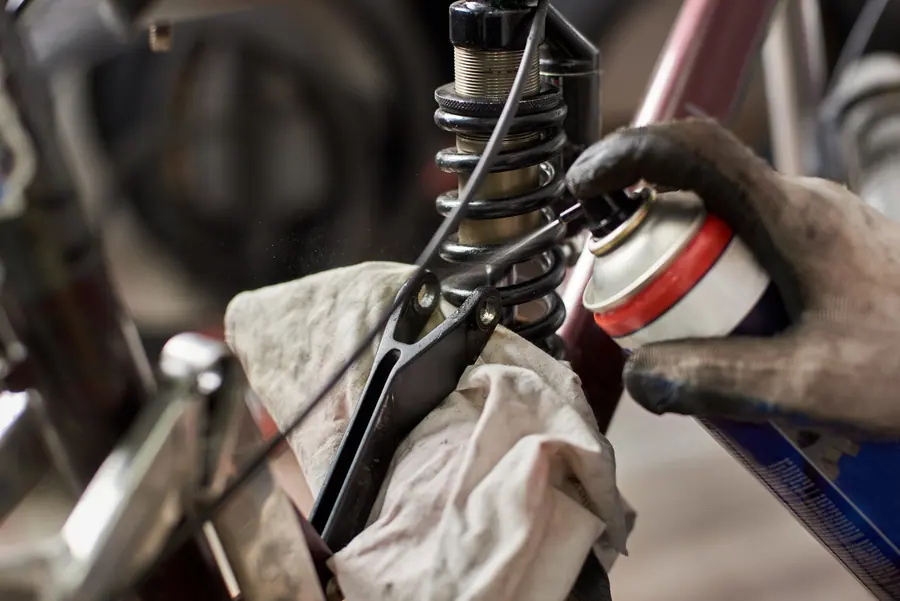
- Lubricate lightlyA garage-door-rated spray on hinges, roller bearings and springs twice a year. Wipe off the excess. Don't grease the track itself; it only collects grit.
- Keep the track and threshold clearSweep out leaves, grit and ice.
- Wash the doorMild soap and water, especially on the lower sections after winter.
What we'd ask you to leave alone: the springs, the cables, the bottom brackets and any bolt painted red. Those are under tension.
The seasonal schedule we recommend around Delafield
Our winters and summers pull a garage door in opposite directions, so two looks a year is ideal — one professional, one your own.
Before winter
Fall is the best time for the professional visit. Lubricant goes on while it's warm enough to penetrate. Seals are checked while vinyl and rubber are still pliable. A spring that's near the end can be replaced on your schedule instead of failing on a ten-below morning with the car inside. Opener force settings are confirmed with enough margin to handle the extra drag that cold brings.
After winter
Once the salt trucks have stopped, rinse the bottom of the door, the lower track and the threshold. Look at the cables near the bottom brackets, where brine sits longest. Check that the bottom seal hasn't been torn by ice. If the door was frozen down at any point and the opener was run against it, listen for new grinding from the motor.
Lake and wooded properties
Homes near Nagawicka, the Nemahbin lakes or under heavy tree cover live in damper air. Springs, cables and fasteners corrode sooner. For those, we suggest coated or galvanized springs when replacement time comes, and a slightly shorter interval between services.
 BEFOREAFTER
Before & after
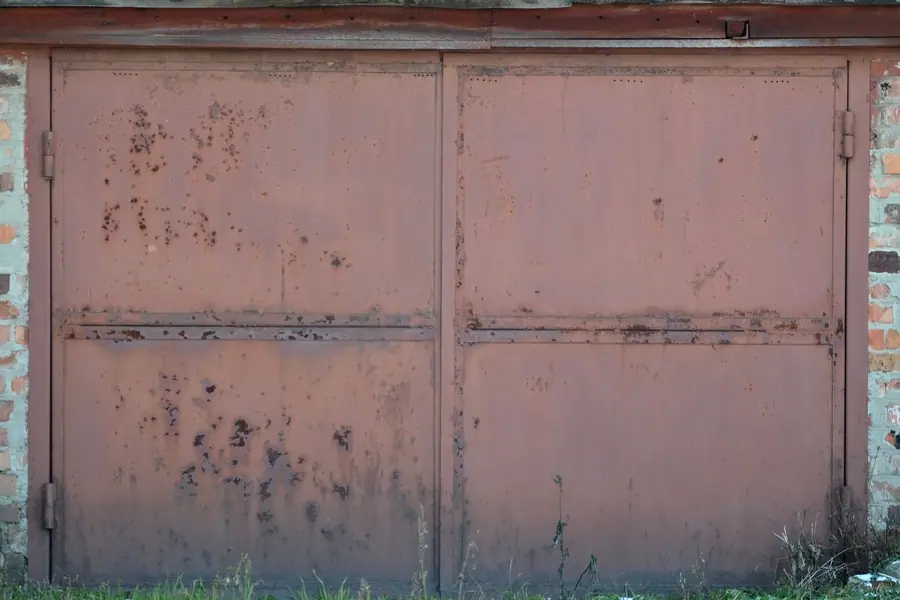
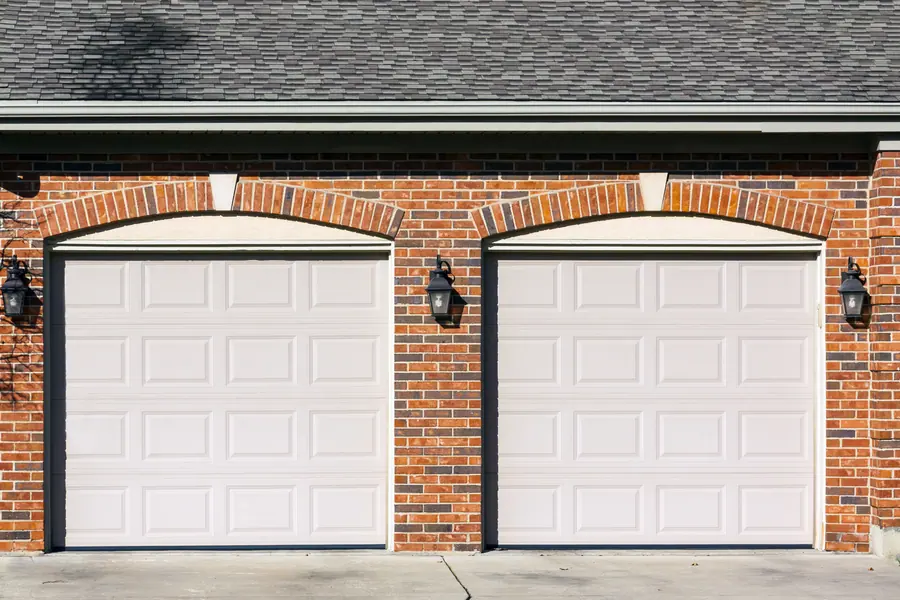
Neglected, corroded doors compared with doors that have been looked after
The "before" image shows what long neglect looks like on steel: paint gone, surface rust across both leaves, and corrosion working into the seams. Doors don't arrive at this point quickly. It takes years of salt, moisture and nobody washing or sealing them, and by the time the face looks like this the hinges and rollers behind it are usually seized or close to it.
The comparison isn't a single repair. It illustrates the outcome of regular care: doors that are washed after winter, touched up when the finish is chipped, lubricated twice a year and adjusted when they drift out of balance.
The "after" image shows doors kept that way. The finish is intact and bright, the panels sit square in their arched openings and the trim is tight. A maintained door like this runs quietly, seals properly and reaches its full service life. The practical benefit is mostly what doesn't happen: no surprise failure, no premature opener replacement, no rusted-through bottom section.
Illustrative exampleThese two photographs are licensed reference images chosen to show the kind of change this service makes. They are not a record of one specific Delafield Garage Door job.
What a technician adds
You can do a fair amount of this yourself, and we've listed how. What a technician adds is judgment and the ability to make adjustments safely.
Balancing a door means adding or releasing spring tension, which shouldn't be attempted without winding bars and training. Reading a spring for fatigue, spotting a cable that's about to let go, or recognizing that a track bracket has shifted takes someone who has seen a few thousand doors. And setting an opener's force correctly matters more than most people realize: too high and the safety reverse won't protect anyone; too low and the door stops whenever the weather turns cold.
A maintenance visit also gives you a baseline. When the same person sees the door each year, small changes stand out.
There's a cost argument as well. An opener replaced early because the door was out of balance, or a section ruined by a hinge that cracked unnoticed, costs several times what the visit that would have caught it does. Maintenance isn't exciting. It's just cheaper than the alternative.
Home maintenance questions
How often should a residential garage door be serviced?
Once a year suits most homes. Doors that cycle heavily, doors near the lakes and older doors benefit from a check every six months.
Is maintenance worth it if nothing is wrong?
That's when it's most useful. The aim is to find wear while it's still a minor adjustment or an inexpensive part instead of a breakdown.
What lubricant should I use on my garage door?
A silicone or lithium-based spray made for garage doors. Avoid heavy grease, which stiffens in the cold, and don't rely on general-purpose penetrating oil as a lubricant — it's a solvent and evaporates quickly.
My door is loud. Will maintenance fix that?
Very often. Most noise comes from dry hinges, worn rollers and loose hardware, all of which are addressed in a standard visit. If the noise has a deeper cause, we'll find it.
Do new doors need maintenance?
Yes. New springs and hardware settle in during the first year, and a check after twelve months catches anything that has loosened.
Will you tell me what's likely to need replacing soon?
Yes. You'll get a plain summary with anything that's wearing, how urgent it is and a rough idea of cost, so you can plan.