A different class of door
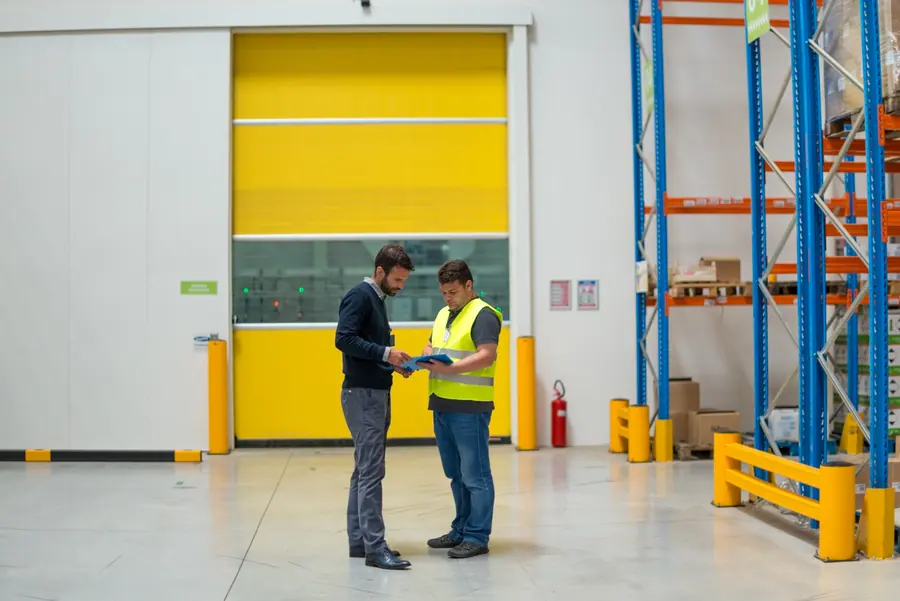
A commercial overhead door does the same basic job as the one on a house. Almost everything else about it is scaled up.
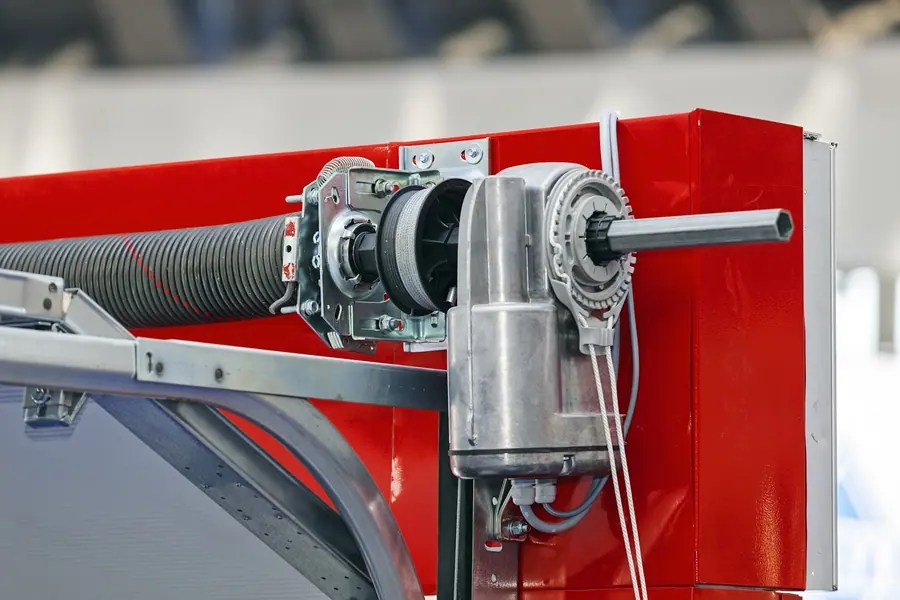
Doors are wider and much taller — twelve, fourteen, sixteen feet high is ordinary. Steel is heavier gauge. Track is three inches wide instead of two. Springs are larger, often in pairs or sets of four, and specified for many more cycles. Shafts are solid steel. Operators are industrial units wired to three-button stations, not consumer openers. And the door may cycle fifty or a hundred times a day.
All of which means failures are more disruptive and the forces involved are greater. A commercial torsion spring assembly can store several times the energy of a residential one. Repairing these doors calls for the right equipment, the right parts and people who've worked on them before.
Who we work for
Around Delafield and western Waukesha County, commercial doors turn up in more places than you might think.
- Auto repair shops, body shops and quick-lube bays
- Contractors' yards and equipment storage
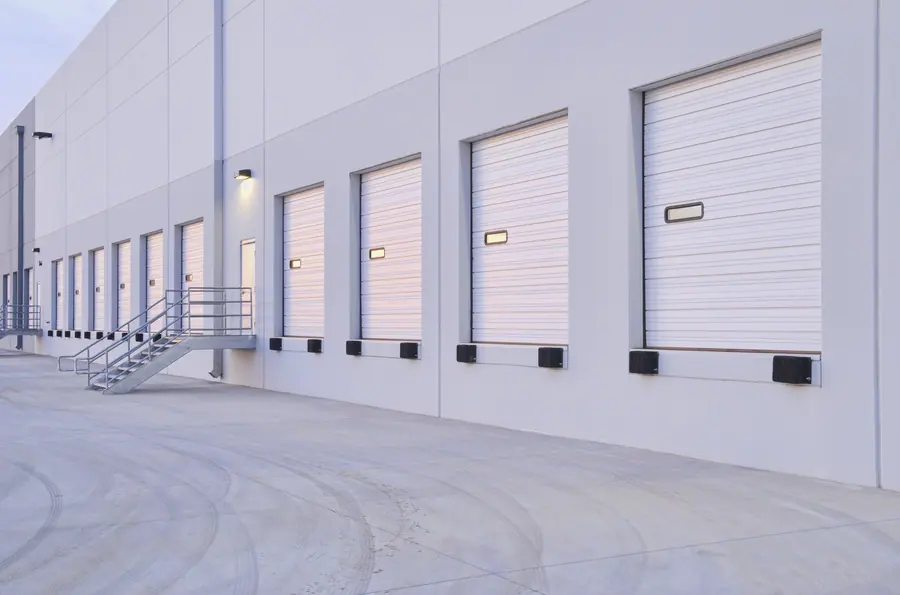
- Warehouses and distribution buildings along the I-94 corridor
- Light manufacturing and fabrication shops
- Municipal garages, fire stations and public works buildings
- Retail and restaurant service entrances
- Self-storage facilities
- Marinas and boat storage around the lakes
- Farms: machine sheds, pole barns, grain and livestock buildings
Each has its own priorities. A fire station needs the door open in seconds, every time. A cold-storage dock needs a tight seal. A farm needs a door that'll clear a combine and survive the dust.
The failures we see on commercial doors
- Broken springs
- The most common failure. A high-cycle spring that's reached its limit, or a standard spring on a door that cycles far more than it was specified for.
- Cables frayed or off the drum
- Caused by broken springs, impacts or worn drums. The door hangs crooked or jams.
- Damaged sections
- Forklifts, trucks and trailers. Usually the bottom section, sometimes several.
- Bent or torn track
- Vehicle strikes, or a door that came out and took the track with it.
- Worn rollers and bearings
- Heavy doors on heavy use wear rollers quickly. Seized end bearings drag on the shaft.
- Operator faults
- Motors, brakes, limit switches, contactors, control stations and safety devices. See operator repair.
- Failed weather seals
- Bottom astragals torn by traffic; jamb and header seals worn through.
- Broken hinges and struts
- Fatigue on wide doors, or damage from impact.
- Doors out of balance
- Springs weakened or the wrong size, making the operator do the lifting.
- Locks and slide bolts
- Bent, seized or left engaged when the operator ran.
How we handle a commercial call
- Triage by phoneDoor size and type, what it's doing, whether it's stuck open or closed, and how critical the opening is to your operation.
- Make it safeOn arrival the first job is securing the door and the area. A heavy door hanging from one cable is a hazard to everyone nearby.
- DiagnoseSprings, shaft, bearings, drums, cables, track, sections, rollers, hinges, operator and safety devices.
- Report and quoteWhat's failed, what else is worn, and the cost. We'll separate "must do now" from "should plan for."
- RepairWith commercial-grade parts matched to the door's size, weight and duty cycle.
- Balance and adjustThe door is balanced by hand before the operator is reconnected. Limits and safety devices are reset.
- TestMultiple cycles under power, with reversing edges and photo-eyes checked.
- DocumentA record of what was done and anything that should be scheduled.
If a part has to be ordered — a special spring, a matching section — we'll secure the opening so the building can be closed and return when it arrives.
Repair, section replacement or a new door?
Commercial doors are built to be repaired. Sections, springs, track and hardware are all replaceable, and a well-made door can run for decades with parts changed as they wear.
We lean toward repair when the damage is confined to one or two sections, the rest of the door is sound, and parts are available. We'll suggest a new door when several sections are damaged or rusted, when the door is uninsulated on a conditioned building, when repeated repairs point to a door past its service life, or when its type simply doesn't suit how the opening is now used.
You'll get both numbers where it's a close call.
Springs: the heart of the matter
Because springs are the most frequent repair, a few specifics.
Cycle rating. Commercial springs are ordered by cycle life: 10,000 is the minimum, with 25,000, 50,000 and 100,000 available. For a door that runs thirty times a day, a 10,000-cycle spring lasts under a year. Matching the rating to actual use is one of the most cost-effective decisions an owner can make.
Multiple springs. Large doors use two, four or more springs on the shaft. When one breaks, the others have the same history. We normally recommend replacing the set.
Duplex and triplex arrangements. Springs nested inside one another to fit more lifting capacity in limited shaft length.
Accurate sizing. We work from the door's weight, height, drum type and lift configuration — standard, high-lift or vertical-lift each change the calculation.
Impact damage
The other staple of commercial repair is a door that's been hit. A forklift mast catches the bottom section. A truck backs into a closed door. A trailer clips the track.
We assess the whole door after a strike, because damage spreads. A bent bottom section twists the hinges above it. A knocked track loosens every bracket on that side. Cables kink. The operator's drive may have been strained.
Preventive measures are worth a conversation: bollards or track guards at vulnerable openings, a properly adjusted open limit so the door clears traffic, and photo-eyes or a reversing edge that work.
 BEFOREAFTER
Before & after
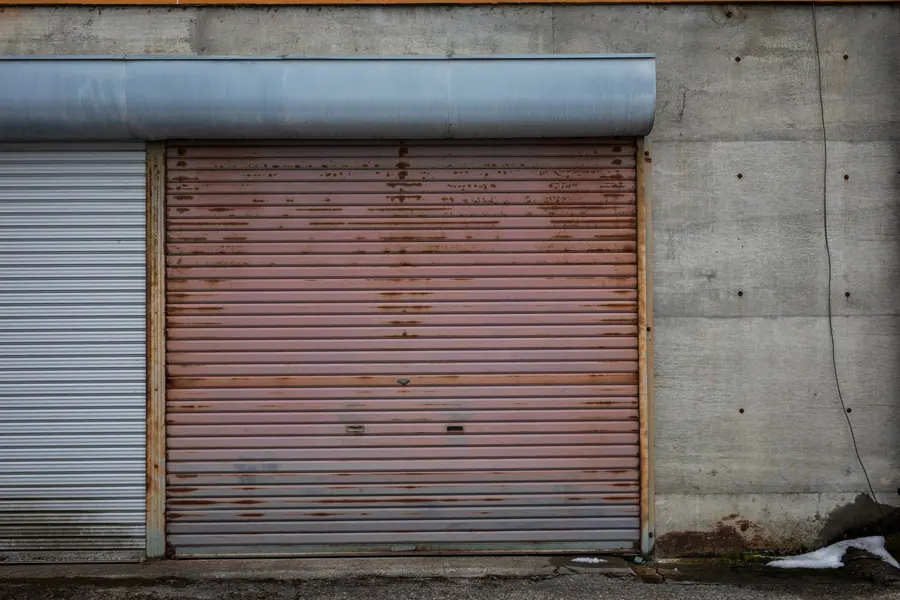
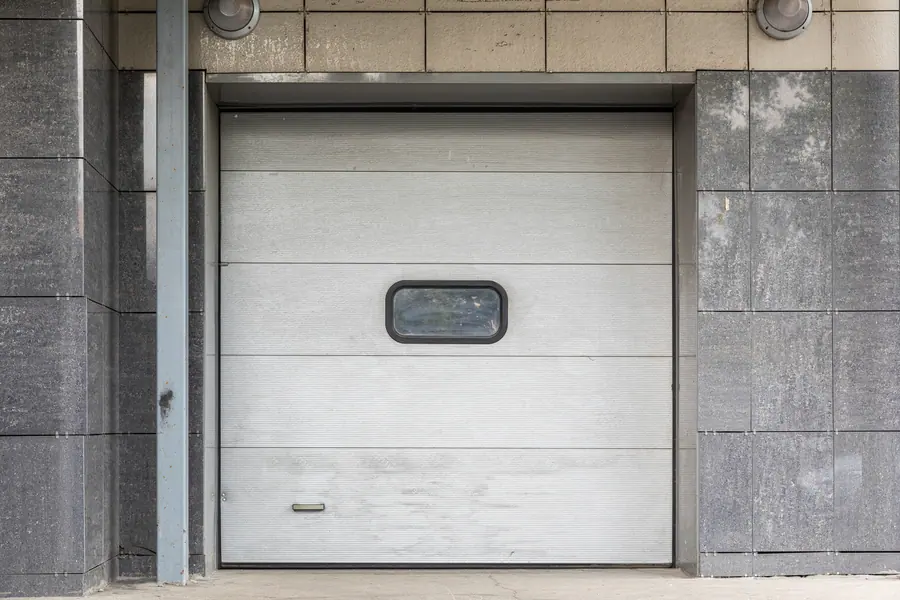
A rusted door on a stained building compared with a clean sectional overhead door
The "before" image shows a roll-up door on a concrete building, rusted across its full face with water staining above and corrosion at the guides. A door in this state is hard to operate, seals poorly and is a steady source of service calls. Rust like this is also a structural issue: fasteners lose their grip and the curtain or sections weaken.
The work illustrated is the kind of repair-or-replace decision commercial owners face. Where the damage is this advanced, the practical fix is a replacement door in the existing opening — here, an insulated sectional overhead door with a vision panel.
The "after" image shows a light gray sectional door, clean and square in a concrete wall. For the building's owner, that means reliable daily operation, an insulated barrier that helps hold temperature, a window that lets staff see what's outside before the door opens, and far fewer calls for emergency repairs.
Illustrative exampleThese two photographs are licensed reference images chosen to show the kind of change this service makes. They are not a record of one specific Delafield Garage Door job.
Commercial doors and Wisconsin conditions
Our climate is hard on commercial doors in ways that are worth planning for.
Salt and slush. Trucks and plows carry brine into every bay. Bottom sections, track bases, cables and bottom brackets corrode from the floor up. Galvanized or stainless hardware in the splash zone pays for itself.
Frozen bottom seals. A door frozen to the slab and then driven by a powerful commercial operator can tear its seal, bend its bottom section or damage the operator. Keeping thresholds clear and drains working matters.
Cold and springs. Steel fatigue shows up in cold weather. January is spring season for commercial doors just as it is for homes.
Wind load. Large doors on open sites west of town take the full force of winter wind. Struts and wind-rated hardware keep sections from bowing.
Energy loss. An uninsulated or poorly sealed door on a heated shop is a significant heating cost. Worn perimeter seals are an inexpensive fix with a quick return.
Agricultural buildings. Unheated, dusty, sometimes damp, and often with doors that sit unused for weeks and are then needed urgently. Lubrication, corrosion protection and a pre-season check before planting and harvest are sensible.
Frost heave. Slabs and aprons shift, changing how the door meets the floor and sometimes racking the opening.
Why commercial doors need a trained technician
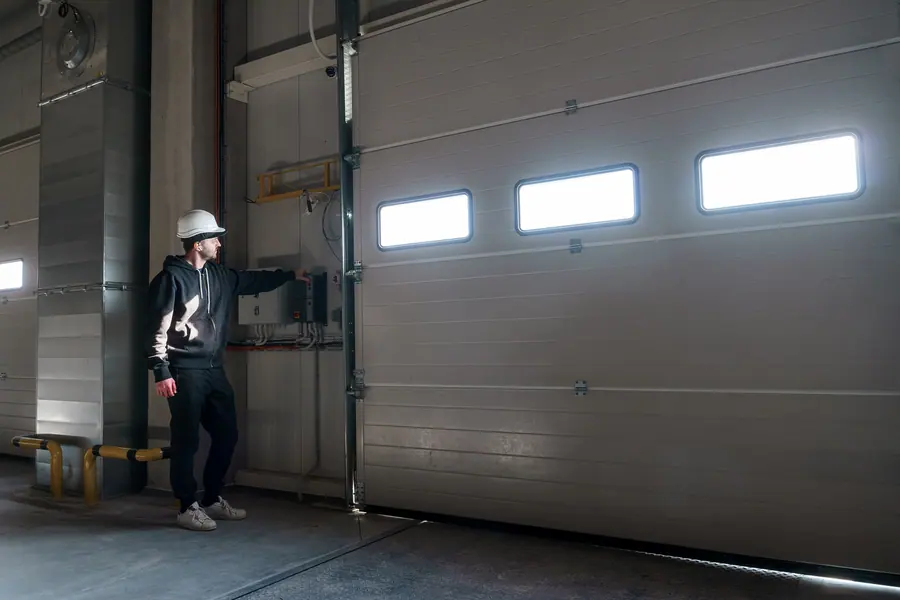
The energy stored in a commercial spring assembly is serious. So is the weight of a fourteen-foot door. Repairs call for proper winding bars, lifting equipment, lockout of the operator and a practiced method.
Beyond the hazards, there's liability. In a workplace, the door is equipment, and its safe operation is the owner's responsibility. Repairs done correctly, with safety devices verified and documented, are part of meeting that responsibility.
There's also the matter of getting it right first time. An hour of downtime at a loading door costs more than the repair. We aim to diagnose fully, fix it properly and flag what's coming, so the next visit is one you've scheduled.
Commercial repair questions
How quickly can you respond to a commercial door failure?
It depends on the day and what's already scheduled. Call and tell us how critical the opening is, and we'll give you an honest timeframe.
Do you repair all types of commercial doors?
We work on sectional overhead doors, rolling steel doors, roll-up sheet doors, dock doors and their operators. If yours is something unusual, describe it and we'll tell you whether we can help.
Can you replace a single damaged section?
Usually, if a matching section is available from the manufacturer. We'll identify the door and check.
What cycle rating should my springs have?
It depends on how often the door runs. We'll ask about daily use and recommend a rating that gives a sensible service life.
Do you work on agricultural buildings?
Yes. Machine sheds, pole barns and farm shops are a regular part of our work.
Can you set up regular maintenance?
Yes. Scheduled inspections are the best way to avoid unplanned downtime. See our commercial maintenance page.