Do garage doors even have locks?
Many people aren't sure. If your door has an opener, there's a good chance you've never used a lock on it.
That's because a modern opener holds the door closed. When the trolley is engaged, the door can't be lifted from outside without considerable force. For day-to-day security on a powered door, that's usually adequate.
But plenty of doors do rely on a mechanical lock:
- Manually operated doors with no opener, common on detached garages and sheds
- Doors on storage units and outbuildings
- Homes where the owner wants a second layer when traveling
- Commercial doors locked at close of business
- Older doors that had a lock installed from new and still use it
And a lock that isn't used can still cause trouble. A slide bolt nudged across by accident, or a lock bar that's dropped into the track, will stop an opener dead — or bend the door when the opener tries to lift it.
The types of lock
- T-handle lock
- An exterior handle with a keyed cylinder, mounted in the center of the door. Turning it rotates a spindle that pulls two cables or rods, withdrawing spring-loaded latches from the tracks at each side.
- Lock bars (side latches)
- The spring latches at each edge of the door that engage slots in the vertical track. Operated by the T-handle or an inside release.
- Inside slide lock
- A simple bolt on the inside of the door that slides into a hole in the track. Operated from inside only. Takes a padlock.
- Keyed cylinder with interior handle
- A flush exterior cylinder connected to an inside handle and lock bars.
- Center-mounted deadbolt
- A floor or jamb bolt on some older and commercial doors.
- Automatic opener deadbolt
- An electric bolt, installed to certain openers, that slides into the track every time the door closes and withdraws before it opens.
- Emergency release lock
- A small keyed cylinder outside, connected by cable to the opener's release. For garages with no other entrance, it lets you disengage the opener from outside in a power outage.
- Roll-up door latch
- A slide latch on the curtain of a sheet door, engaging the guide and taking a padlock or cylinder.
Common lock faults
Worn key, worn or dirty cylinder, corrosion, or ice in the keyway.
A broken spindle, a snapped cable or a disconnected rod behind the handle.
A cable has stretched or broken, or a latch spring has failed.
The door or track has shifted, so the latch no longer lines up with its slot.
Bent bars, seized pivots, or a door that's sagged and is binding on the latch.
Rust, paint or a bent bolt.
A lock is engaged. Check the inside slide bolt and lock bars before anything else.
The opener was run with the lock on.
The bolt doesn't extend or retract, usually alignment, wiring or a failed unit. The opener will signal an error.
The lock works but nobody can find the key.
How we repair locks
- Identify the lock type and the faultFrom outside and inside. Much of the mechanism is on the inner face of the door.
- Free the door if it's stuckIf a jammed lock is holding the door shut, we release it without damaging the door.
- Inspect the linkageHandle, spindle, cables or rods, latches, springs and the slots in the track.
- Check alignmentWhether the latches meet the track where they should. If the door has dropped or the track has moved, that's corrected.
- Repair or replaceCylinders, handles, cables, latch assemblies or the complete lock set, as needed.
- LubricateA dry graphite or PTFE lubricant in the cylinder; light oil on pivots.
- Rekey if requiredCylinders can often be rekeyed or replaced to suit a new key.
- TestLocked and unlocked several times from both sides, and the door operated to confirm nothing binds.
- Protect the openerWhere a manual lock and an opener coexist, we'll discuss disabling one or fitting an interlock.
Locks and openers together: a caution
This causes more damage than any lock failure.
If a door has both an opener and a manual lock, and the lock is engaged when someone presses the remote, the opener pulls on a door that's bolted to its track. Something gives. Usually the top section buckles at the opener bracket; sometimes the track tears or the opener's drive gear strips.
There are sensible ways to prevent it.
- Remove or disable the manual lock on a powered door if you never use it
- Use the opener's own lock feature. Many wall controls have a button that disables the remotes while you're away
- Unplug the opener when you engage a manual lock for a long absence, and leave yourself a note
- Fit an automatic deadbolt if your opener supports one. It locks and unlocks itself in step with the door
Improving garage security
Lock repair often leads to a wider conversation about security. A few measures are worth knowing.
- Rolling-code remotes. If your opener predates the mid-1990s, its fixed code can be copied. A new opener closes that gap.
- Erase lost remotes. If one has gone missing, wipe the opener's memory and reprogram the rest.
- Shield the emergency release. On some doors the release cord can be hooked from outside through the top of the door. A simple shield or a zip tie through the release lever's hole — one that still breaks with a firm pull — prevents it.
- Frosted or no glass. So nobody can see what's inside or whether the car is gone.
- Automatic close and alerts. A smart opener can shut a door left open and tell you about it.
- Lock the door into the house. Treat it like an exterior door, because it is one.
- Good lighting. Motion-activated lights at the garage discourage attention.
Lock replacement options
If the existing lock is beyond economical repair, there are choices.
A like-for-like T-handle set is inexpensive and restores what you had. An inside slide lock is the simplest secondary security for a manual door. For powered doors, an opener-integrated deadbolt is the most convenient. And for garages with no other entrance, an exterior emergency release lock is close to essential.
On commercial doors and sheet doors, heavier slide locks and cylinder latches are available, and can be keyed to match other locks on the site.
 BEFOREAFTER
Before & after
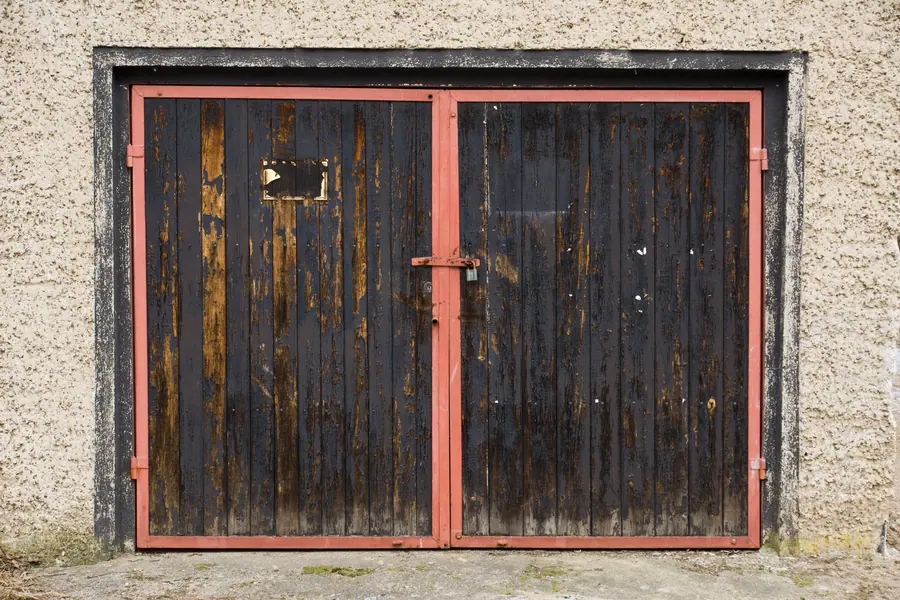
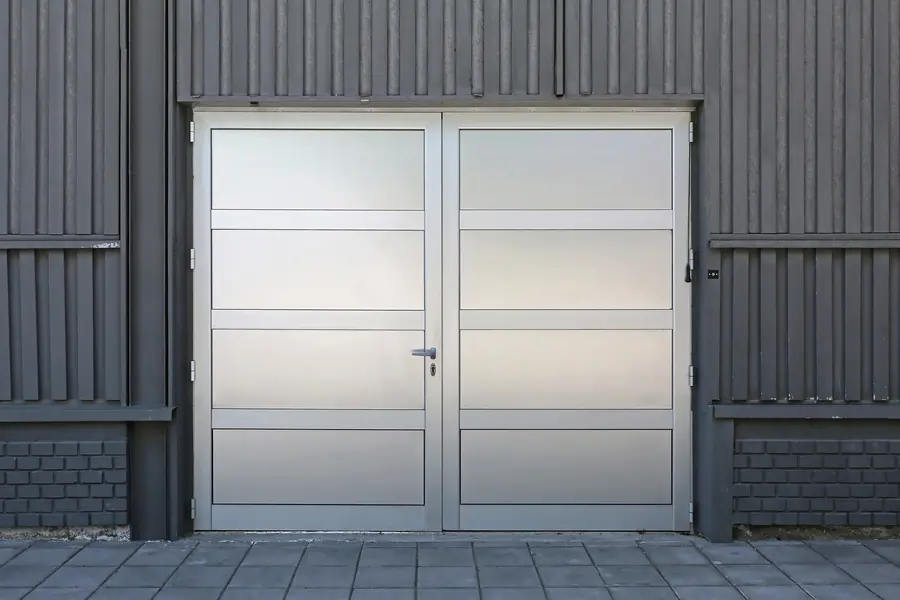
Old doors with a broken latch compared with a door installed with a working lock
The "before" image shows a pair of old wooden doors with a broken latch. The boards are dark and weathered, the red-painted frame is flaking, and the hasp hangs loose with nothing securing it. Doors like this are held shut by habit more than hardware. They can be pulled open by anyone, and they don't close tightly enough to keep weather out either.
The work illustrated is the fitting of proper locking hardware as part of a door upgrade — a sound door with a working handle and lock in place of leaves that could no longer be secured.
The "after" image shows a clean metal double door with a lever handle and lock, set square in its opening. It closes fully and it locks. For the owner, the benefit is the obvious one: tools, vehicles and equipment behind a door that can't simply be pulled open, operated by a key that turns easily and a latch that lands where it should.
Illustrative exampleThese two photographs are licensed reference images chosen to show the kind of change this service makes. They are not a record of one specific Delafield Garage Door job.
Locks in a Wisconsin winter
Exterior locks and our climate don't always get along.
Frozen cylinders. Moisture gets into the keyway and freezes. The key won't go in, or goes in and won't turn. A lock de-icer or a key warmed in your hand usually frees it. Don't force the key, and don't pour hot water on it — it refreezes worse. A dry lubricant applied in the fall helps keep water out.
Stiff mechanisms. Oil-based lubricants thicken in the cold and gum up the pins. We use graphite or PTFE in cylinders for that reason.
Corrosion. Road salt and damp air attack zinc and steel lock parts. T-handles on doors facing the street corrode first. Stainless or brass components last longer.
Frost heave and misalignment. When the slab or framing shifts with the frost, the door sits differently in its opening. Latches that lined up with their slots in September miss them in February. If your lock works in summer and not in winter, that's likely the reason, and the fix is adjustment, not a new lock.
Ice on the slide bolt. Condensation freezes interior slide locks in place.
Snow and outbuildings. Detached garages and sheds with manual locks are the ones people need to get into for the snowblower. A lock serviced before winter is one less thing to fight with at six in the morning.
Why call us for a lock
Replacing a T-handle is manageable for a handy homeowner. The difficulty is usually in the linkage and alignment behind it — and in getting a jammed door open without making things worse.
There's also the interaction with the opener and with the door's own hardware. Lock bars sit near the cables and bottom brackets, which are under spring tension. Drilling or unbolting in the wrong place is a risk.
We carry lock sets, cylinders, cables and latches for the common door types, and we'll check the door's alignment while we're there so the new lock keeps working.
Lock questions
My garage door key won't turn. What should I try?
In freezing weather, use a lock de-icer. Otherwise a small amount of dry graphite lubricant in the keyway often helps. If it's still stuck, the cylinder or linkage needs attention.
Can you rekey a garage door lock?
Many cylinders can be rekeyed or replaced so a new key operates them. We'll check what's installed.
Do I need a manual lock if I have an opener?
Not necessarily. The opener holds the door closed. A lock adds security for long absences, but it must never be engaged while the opener is in use.
My opener won't lift the door and I heard a clunk. Could it be the lock?
Yes. Check the inside slide bolt and lock bars. If the opener ran against an engaged lock, have the door inspected for damage.
What is an automatic garage door deadbolt?
An electric bolt connected to the opener that locks the door to the track each time it closes and releases before it opens. Available for certain opener models.
I have no other door into my garage. What if the power goes out?
An exterior emergency release lock lets you disengage the opener from outside with a key, so the door can be lifted by hand.