What counts as an emergency
Not every garage door problem is urgent. A noisy roller can wait. These can't.
The door won't open and you need the vehicle — for work, an appointment, or because it's the only one you have.
The house or building is exposed to weather and to anyone passing. In winter an attached garage loses heat fast.
Hanging crooked, jammed, or with rollers out. It's unstable.
The door could come down hard.
Bent sections, damaged track, a door that won't move or won't close.
A commercial building that can't be secured overnight.
Something in the counterbalance has failed.
Call 911 first. Then call us.
First: make it safe
Before anything else, a few things apply in almost every urgent situation.
- Keep people away from the doorChildren, pets, curious neighbors. Nobody under it or beside it.
- Stop using the openerDon't keep pressing the button. Unplug the unit if you can reach the plug safely.
- Don't touch springs, cables or bottom bracketsThey're under tension even when something has broken.
- Don't pull the red release cord if the door is open or partly openIt may be the only thing holding the door up.
- Don't try to force the doorUp, down or back into its track.
- Take a photoIt helps us understand the situation before we arrive and bring what's needed.
- CallDescribe exactly what you see.
What to do in each situation
The door won't open and the car is inside
Look above the door. If there's a gap in the torsion spring's coil, the spring has broken and the door is at full weight. Don't run the opener.
If the spring looks intact, check simpler things: is the opener plugged in, has a breaker tripped, is the wall control's lock switch on, is the door frozen to the floor?
If you must get the car out before we can arrive, tell us. With the door closed, the release pulled, and two capable adults lifting evenly from the bottom, a door with a broken spring can sometimes be raised and safely propped by someone who knows how. We'd rather guide you through that by phone than have you improvise — and if there's any doubt, wait.
The door is stuck open
If it's fully open and stable, leave it there and keep the area beneath it clear. Don't pull the release.
If the opener runs but the door won't come down, check the photo-eyes at the floor. A blocked or misaligned sensor is the usual cause, and holding the wall button down will normally override it and close the door while you watch.
If it won't close at all, move valuables out of sight, lock the door between the garage and the house, and call us.
The door is crooked or off its track
Stop. Leave it exactly as it is. A door in this state can shift or drop if disturbed. See our page on off-track doors.
A vehicle hit the door
Check that everyone's all right. Then leave the door alone. Even if it still moves, bent track and creased sections can let it come out on the next cycle. If the door has been pushed outward and is leaning, keep well clear.
The door came down fast
A spring or cable has failed. The door is now closed, which is the safest place for it. Leave it and call.
How we respond
- You call and describe itThe more detail, the better: door size, what you heard, what you see, whether it's up or down.
- We advise immediatelyHow to make the situation safe, and whether there's anything sensible you can do yourself.
- We give you an honest timeframeWe'll tell you straight when we can get there. We'd rather give you a realistic time than a promise we can't keep.
- We secure the doorFirst priority on arrival. An unstable door is made safe before any repair starts.
- We diagnose and quoteYou'll know what's wrong and what it costs before we begin.
- We repair if we canSprings, cables, rollers, track and most opener faults are commonly fixed on the first visit.
- If parts are neededWe secure the opening so it's closed and locked, and return when they arrive.
- We testBalance, travel and safety reverse, as on any job.
What can usually be fixed on the spot
Most urgent calls are caused by a short list of failures, and we carry the parts for them.
- Broken torsion and extension springs
- Frayed, snapped or jumped cables
- Doors off their track
- Failed rollers and broken hinges
- Bent track that can be straightened or swapped
- Opener faults: gears, capacitors, sensors, trolleys
- Doors frozen to the floor
- Jammed locks and latches
What may need a return visit: matching replacement sections for a damaged door, special-order springs for unusual doors, and replacement operators for commercial doors.
Securing a door that can't be fixed immediately
Sometimes the right part isn't on the truck. That doesn't mean leaving you with an open garage.
Where a door can't be made operable the same day, we can usually close it manually and lock it, brace damaged sections, or board a section that's been torn. The aim is a building that's weathertight and secure until the proper repair can be completed.
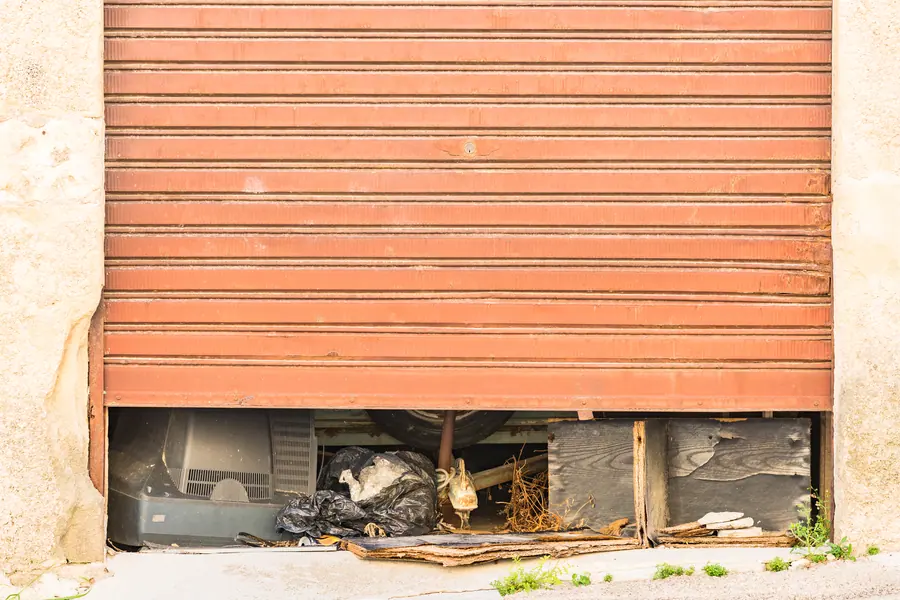
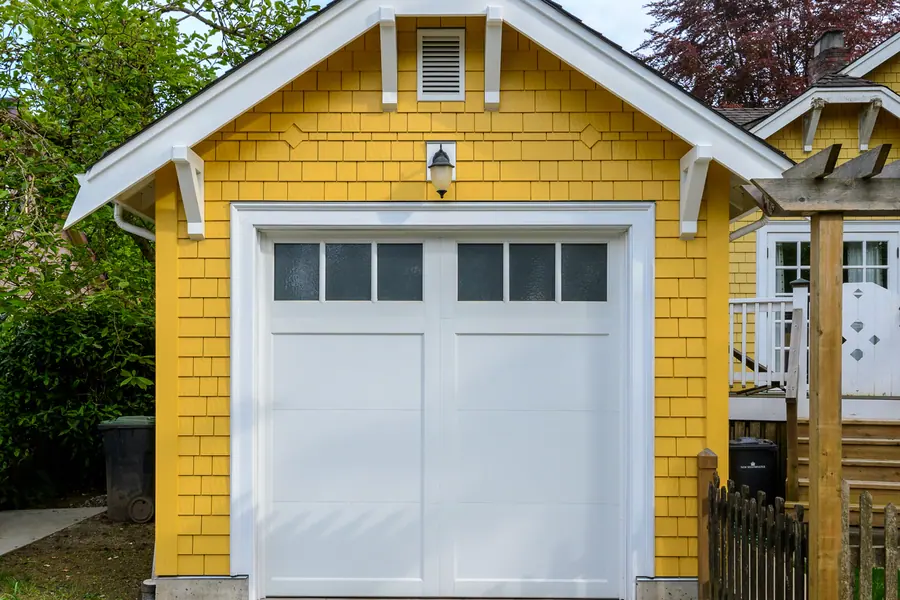 BEFOREAFTER
Before & after
A crushed, torn door section compared with a sound, working door
The "before" image shows a door with its bottom section crushed and torn open, debris visible through the gap. This is what a hard impact does: the lowest panel folds, its hardware tears free and the opening is no longer closed. A door like this can't be operated, can't be locked and lets weather and animals straight in. It's a genuine emergency for whoever owns the building.
The response illustrated runs in two stages. First the opening is secured so the building can be closed. Then the door is repaired or replaced — damaged sections, track and hardware renewed, springs rebalanced and the opener checked.
The "after" image shows a small garage with a clean white door closed evenly in its frame. That's the outcome that matters in an emergency: a door that shuts, seals and locks again. Everything else — the tidy appearance, the smooth operation — follows from getting that right.
Illustrative exampleThese two photographs are licensed reference images chosen to show the kind of change this service makes. They are not a record of one specific Delafield Garage Door job.
Winter emergencies around Delafield
Cold weather is when urgent calls peak, and they have a particular flavor.
Springs on the coldest morning. Fatigued steel gives up when the temperature plunges. If there's a deep freeze in the forecast and your springs are old, it's worth having them checked beforehand.
Doors frozen to the floor. Meltwater under the seal freezes overnight. Don't keep running the opener — that's how gears strip and panels buckle. Pull the release, then work along the bottom edge with warm water or careful chipping, and dry the threshold afterward.
Doors stuck open in the cold. An open garage door on an attached garage at ten below is a real problem. The house loses heat, and any water lines in the garage can freeze. If we can't get there quickly, close the interior door, block drafts at its threshold and, if there are pipes at risk, let a faucet drip.
Power outages. Ice and heavy snow take lines down. Know where your manual release is. If lifting the door by hand isn't realistic for you, battery backup is worth having.
Snow-related impacts. Narrow, snow-banked driveways and frosted windows lead to bumped doors and tracks.
Ice in the tracks. Rollers ride up over frozen meltwater and out of the channel.
A little preparation in the fall — a tune-up, fresh lubricant, a look at the springs and seals — prevents a good share of these.
Why you shouldn't improvise
When you're stuck, the temptation to do something — anything — is strong. We understand. The reason we keep saying "leave it" is that garage door emergencies are almost always failures in the counterbalance system, and that's where the danger is.
A door with a broken spring weighs what it weighs. A cable that has slipped can release suddenly. A door off its track isn't supported. People are seriously injured every year trying to lift, prop or force doors in these states.
A phone call costs nothing. We'll tell you what's safe to try and what isn't.
Emergency questions
Do you offer 24-hour emergency service?
Call us with what's happened and we'll tell you honestly how quickly we can respond. If we can't get there as soon as you need, we'll say so and help you make the door safe in the meantime.
My car is trapped. Can I open the door myself?
Sometimes, with care and help. If a spring is broken the door is extremely heavy. Call us first and we'll advise whether it's safe to attempt.
My door is stuck open. What should I do tonight?
Check the photo-eyes and try holding the wall button to close it. If that fails, secure the house door, remove valuables from view and call us.
Is it safe to leave a door with a broken spring closed?
Yes. Closed is the safest position. Just don't operate it.
A car hit my garage door. Can it be repaired?
Often. It depends on how many sections and how much hardware were damaged. We'll secure it first, then assess.
Will my homeowner's insurance cover the damage?
Coverage varies by policy and cause. We can provide a written description of the damage and the repair for your insurer.