The hardest-working strip of rubber on the house
Every time your garage door closes, its bottom edge presses a flexible seal against the concrete. That seal has to squash down enough to fill every dip in the floor, spring back thousands of times, stay soft at twenty below, survive being driven over by grit and salt, and release cleanly when the door opens.
For a few years it does all that without complaint. Then the rubber hardens. It takes a permanent flat set. Cracks open across it. A corner tears where it froze to the floor one February. And one day you notice a line of daylight under the door, or a puddle inside after a thaw, or acorn shells in the corner that weren't there last week.
This page is about that bottom seal and the threshold it meets. The seals around the sides and top of the door are covered on our weatherstripping page.
How to tell yours is finished
A quick check takes two minutes.
- Close the door in daylight and turn off the lightsStand inside and look along the bottom edge. Any light showing is a gap.
- Feel for draftsOn a windy day, run a hand along the floor at the door. Moving air is easy to detect.
- Look at the seal with the door openPinch it. It should be soft and springy. If it's hard, cracked, flattened or crumbles, it's done.
- Check the cornersThe ends are where seals tear and where gaps most often open.
- Look for evidenceWater stains, a line of grit or leaves blown in, or droppings near the door all point to a failed seal.
Types of bottom seal
The right seal depends on the retainer your door has and the condition of your floor.
- T-style (T-end)
- A flat strip with a T-shaped bead along each edge that slides into a double-channel retainer. The most common type on modern steel doors.
- Bulb
- A round or teardrop tube that compresses against the floor. Good at filling uneven surfaces. Common on doors with a single-channel retainer.
- Bead-end
- Similar to T-style, with rounded beads sized for particular manufacturers' retainers.
- J-type and L-type
- Folded profiles that form a hook shape when closed. Found on certain door brands.
- Nail-on or screw-on strip
- A flap fixed directly to the bottom of a wood door. Simple and still used on older timber doors.
- Brush seal
- A row of dense bristles. Useful on commercial doors and very uneven floors, though less airtight.
Seals also come in different widths. A wider seal — four inches or more — has more material to fill a gap, which matters on floors that have settled or heaved.
Material matters in this climate
Inexpensive and widely installed from new. It stiffens badly in the cold and tends to crack within a few Wisconsin winters.
Stays flexible well below zero, resists UV and lasts longer. Our usual choice.
Premium options that remain very soft in deep cold and are less inclined to freeze to the floor.
The retainer: the part behind the seal
The seal slides into a channel fixed along the bottom edge of the door, called the retainer. If the retainer is in good shape, replacing the seal is quick. Often it isn't.
Aluminum retainers corrode where salt water sits in the channel. Steel ones rust. The channel gets crushed in spots, or pulls away from the door where its screws have loosened in a rusting bottom section. When that happens, the new seal can't slide in or won't stay put.
We check the retainer every time. If it's damaged, we replace it along with the seal. On an older door where the bottom edge itself has rusted, a new retainer sometimes gives the seal a sound surface to mount to and buys the door several more years.
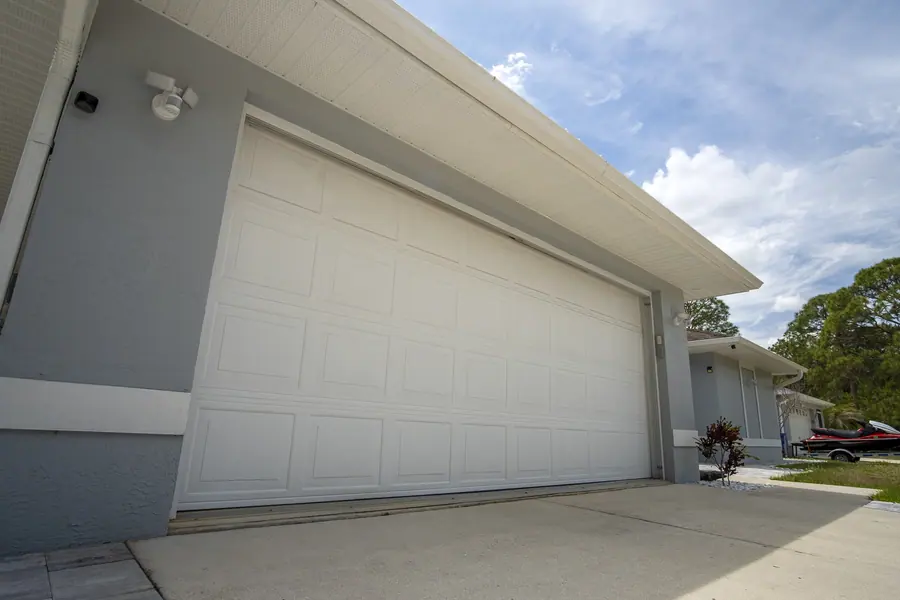
When the floor is the problem
A perfect seal can't close a gap it can't reach. Garage floors are seldom flat, and around here they move.
- Settled or heaved slabs. If the floor has dropped at one corner or lifted in the middle, a standard seal won't make up the difference. A wider seal, or a bottom section scribed to the floor, may.
- A slope toward the garage. Where the driveway pitches down to the door, water runs straight under. A threshold is the answer.
- Pitted or spalled concrete. Road salt eats the surface at the threshold. A rough, cratered floor won't seal against anything.
- A lip or step. Seals wear fast where they close across an edge.
Threshold seals
A threshold is a raised rubber or vinyl strip bonded to the floor directly under the door. The door's bottom seal closes onto its peak, forming a dam. It's very effective against water running in from a sloped driveway and against wind-driven rain and snow. It needs a clean, dry, sound floor to bond to, so it's a job for mild weather.
How we replace a bottom seal
- AssessSeal type, retainer condition, floor profile and the size of any gaps.
- Raise the door to working heightThe opener is disconnected and the door secured.
- Remove the old sealIt's slid or cut out of the retainer. Old vinyl often has to be pulled out in pieces.
- Clean or replace the retainerGrit, corrosion and old sealant are cleared from the channels. A damaged retainer is swapped.
- Fit the new sealLubricated lightly and fed through the channels, then trimmed with a little extra at each end to tuck back and close the corners.
- Check against the floorThe door is lowered and the contact line inspected along its full width, with the lights off.
- Adjust the openerA thicker, softer seal changes where the door stops. The close limit and force are reset so the door seats without crushing the seal or reversing.
- Add a threshold if neededPositioned with the door closed, marked, and bonded to the prepared floor.
 BEFOREAFTER
Before & after
A worn threshold with gaps compared with a door seated on a new seal
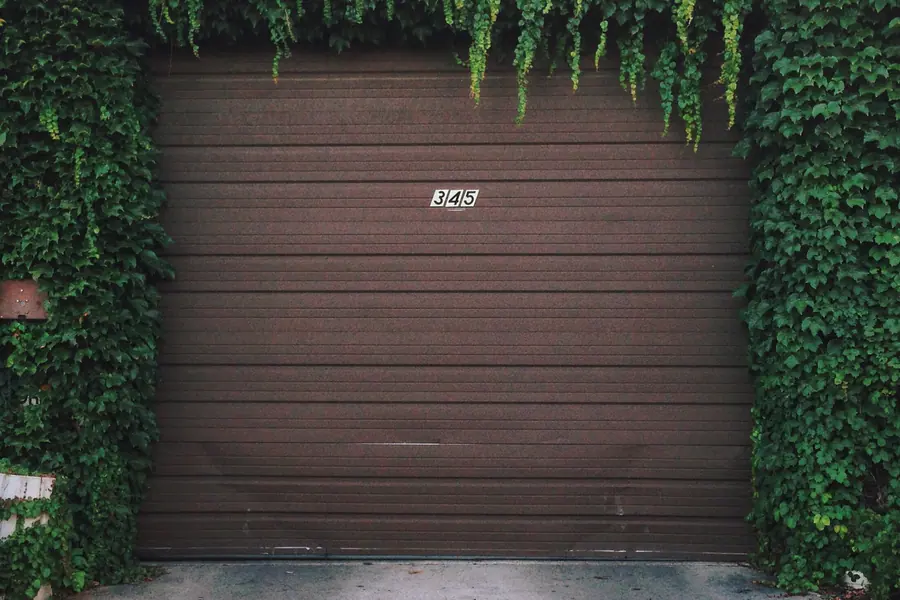
The "before" image shows an older brown door with ivy trailing over the lintel and a threshold that has seen better days. The concrete is stained and pitted in front of it, and the bottom edge of the door doesn't sit in firm contact along its width. A door in this condition lets air move freely underneath, lets meltwater run in, and gives leaves and small animals an easy way through.
The service illustrated is a bottom seal replacement together with threshold attention: the old seal and retainer removed, a new retainer installed to the bottom section, a cold-flexible seal installed, and the opener's close limit reset.
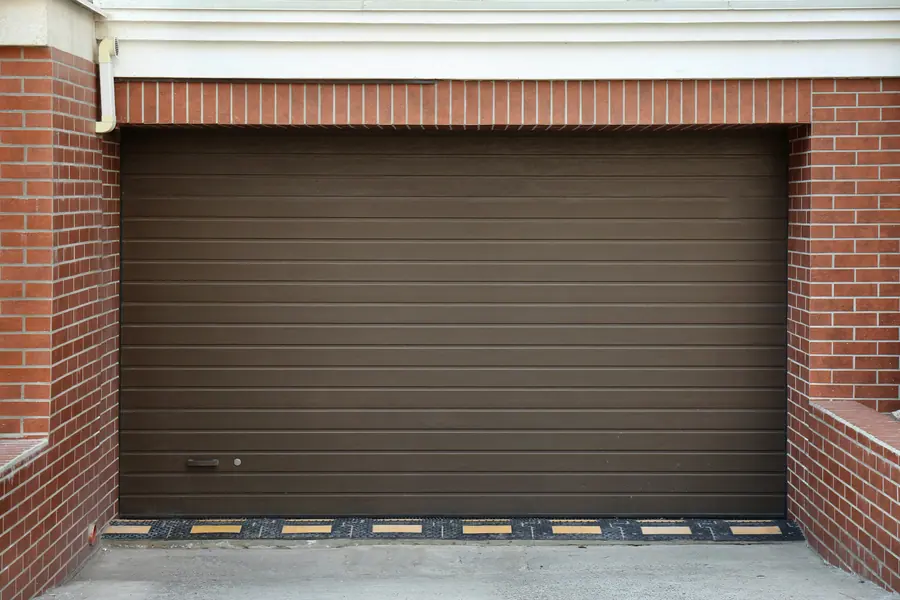
In the "after" image the door sits down on a visible seal strip that runs the full width of a clean opening. The contact line is continuous from corner to corner. That translates directly into a drier floor, fewer drafts across the garage, less salt and grit blown inside, and a noticeably quieter close as the door lands on rubber instead of concrete.
Illustrative exampleThese two photographs are licensed reference images chosen to show the kind of change this service makes. They are not a record of one specific Delafield Garage Door job.
Bottom seals and a Wisconsin winter
If there's one part of a garage door that feels our climate most directly, it's this one.
Freezing to the floor. Snow melts off the car, runs to the door, pools at the seal and freezes overnight. In the morning the door is stuck down. If the opener is triggered, something has to give: the seal tears, the opener's gear strips, or the top section buckles. A flexible seal that sheds water and a threshold kept clear of ice reduce the risk. So does a quick spray of silicone on the seal's contact face before winter, which makes ice less inclined to bond.
Hardening. Vinyl seals lose their flexibility in deep cold and stop conforming to the floor just when you need them most. EPDM and silicone stay pliable.
Frost heave. Slabs lift and tilt as the ground freezes. A gap that isn't there in September can appear by January at one corner. A wide, soft seal gives some margin for that seasonal movement.
Salt. Brine at the threshold corrodes aluminum retainers and breaks down the concrete surface. Rinsing the threshold in spring slows both.
Mice. As the nights get cold, mice look for warmth, and a mouse can squeeze through a gap the width of a pencil. The lower corners of a garage door are a favorite route.
If your door freezes down: don't keep pressing the button. Release the opener, free the seal with warm water or by chipping gently along the edge, and dry the area. Then call us about the seal.
Why have it installed professionally
Feeding a sixteen-foot seal through a clean, straight retainer is manageable for two people. It becomes awkward quickly when the retainer is corroded, the profile is unusual or the floor is uneven.
A technician will identify the correct seal for your retainer, replace the retainer if it needs it, and — the step most often missed — reset the opener's travel and force. A new seal is thicker than the worn one it replaces. If the opener isn't adjusted, the door may hit the floor early and reverse, or drive down hard and crush the new seal flat within weeks.
Bottom seal questions
How often should a garage door bottom seal be replaced?
It varies with material and exposure. Vinyl seals may last only a few years here; good rubber seals often last considerably longer. Inspect yearly and replace when it's hard, cracked or no longer closes the gap.
Why is there a gap at one corner of my door?
Usually the floor isn't level, or the door isn't sitting level because of a cable or track issue. We check both before fitting a seal.
Will a new seal keep mice out?
A properly installed bottom seal, together with intact side seals at the lower corners, removes the most common entry points.
What is a threshold seal?
A raised strip bonded to the floor under the door. The door closes onto it, creating a barrier against water running in from the driveway.
My door reverses after I installed a new seal. Why?
The new seal is thicker, so the door reaches the floor sooner than the opener expects. The close limit needs adjusting.
Can the seal be replaced in winter?
Yes. Threshold strips that rely on adhesive are better installed in milder weather, but the door's own bottom seal can be changed at any time of year.