What the hinges are doing
A sectional door is four or five rigid slabs. To get from standing upright in the opening to lying flat under the ceiling, it has to bend at every joint. Hinges make that possible.
On a typical door there are two kinds of hinge doing two different jobs. The center hinges run in one or more columns up the middle of the door and simply join each section to the next. The end hinges, at each side, do that too — and they also carry the rollers. The roller stem slides into a sleeve formed in the hinge, so the end hinges are part of how the door is guided along the track.
Every time the door moves, each hinge pivots open and closed. Over ten years that's tens of thousands of movements under load, in a garage that swings from humid summer heat to deep cold. It's no surprise they wear.
Why hinges are numbered
Look closely at the end hinges and you'll see a number stamped into each: 1, 2, 3 and so on. That's not a part count. It tells you where the hinge belongs.
Garage door track isn't perfectly vertical. It leans away from the opening slightly as it rises, so the door seals tightly against the jambs when closed and pulls clear as it lifts. To follow that slope, each end hinge up the door holds its roller a little further from the door face.
- No. 1 hinge
- Joins the bottom and second sections. Its roller sleeve is closest to the door. Also used as the center hinge at every joint.
- No. 2 hinge
- Between the second and third sections. Sleeve stands slightly further out.
- No. 3 hinge
- Between the third and fourth sections. Further out again.
- No. 4 and up
- On taller doors with more sections, continuing the progression.
- Top fixture
- Not a hinge, but an adjustable bracket holding the top roller. Sets how tightly the top section meets the header.
- Bottom fixture
- The bracket at each lower corner that holds the bottom roller and the lift cable. Under spring tension.
Fitting the wrong number in a position — a common DIY mistake — makes the door bind or leaves a gap against the weatherstrip.
Signs a hinge needs replacing
- A visible crack, usually across the knuckle or beside a screw hole
- A hinge leaf bent or twisted out of flat
- Elongated holes where the fasteners have worked back and forth
- A wallowed-out roller sleeve, letting the roller stem rattle
- Rust that has pitted or seized the pivot
- Popping, cracking or creaking as the door passes through the curve
- A gap opening between two sections when the door is closed
- Sections out of line with each other on the outside face
- Black dust or metal shavings below a hinge, which means it's grinding itself away
Center hinges on wide double doors are the usual first casualties. The middle of a sixteen-foot door flexes more than the edges, and that movement concentrates at the hinge knuckles.
Gauge: the detail that determines how long they last
Hinge steel is measured in gauge, and lower numbers are thicker.
Light-duty. Often supplied on builder-grade doors. Adequate on a light single door; prone to cracking on anything wider.
The standard for quality residential doors. Noticeably stiffer, with much better resistance to cracking.
Heavy-duty. Used on commercial doors, wood doors and wide or heavy residential doors.
For heavy doors that use two rollers at each end joint, spreading the load.
When we replace failed hinges, we usually step up a gauge. A cracked 18-gauge center hinge on a double door is telling you the original wasn't up to the job, and putting the same thing back just restarts the countdown.
How hinges are replaced
Hinges are among the safer parts of a door to work on, with care about the order.
- Inspect all of themWe check every hinge and fastener, not just the obviously damaged one. Where one has cracked, its neighbors have shared the same stress.
- Close and secure the doorHinges are changed with the door fully down, so each section is resting on the one below. The opener is disconnected.
- One at a timeOnly one hinge is removed at once, so the sections stay joined and aligned.
- Remove the old hingeFasteners out; on an end hinge, the roller is eased from the track and transferred or replaced.
- Fit the new hingeCorrect number for the position, correct gauge for the door, seated flat across the joint.
- Deal with stripped holesWhere screws no longer bite, we use a larger fastener, a through-bolt with a backing plate, or shift the hinge slightly to fresh steel.
- Tighten everythingEvery hinge fastener on the door gets checked. Loose hardware is the cause of a great deal of noise and wear.
- Lubricate and testA light lubricant on each pivot, then the door is run by hand and under power.
The bottom fixtures are the exception to "safe." They're under cable tension and are only touched with the springs unwound.
Why hinges fail early
Hinges should last a long time. When they don't, there's usually an underlying cause.
- No struts on a wide door, so the sections flex and the center hinges take the strain
- An unbalanced door that jerks at the start of each cycle
- An opener with too much force, slamming the door into the floor or the stops
- Track out of alignment, twisting the end hinges every time the rollers pass
- Loose fasteners allowing the hinge to rock and fatigue
- Corrosion from road salt and condensation
- A previous impact that bent the section and stressed the hinge line
We look for these while we're there. Replacing hinges without addressing a flexing door or a bad track simply gives you newer cracked hinges in a few years.
 BEFOREAFTER
Before & after
A rust-seized hinge compared with clean plated hardware
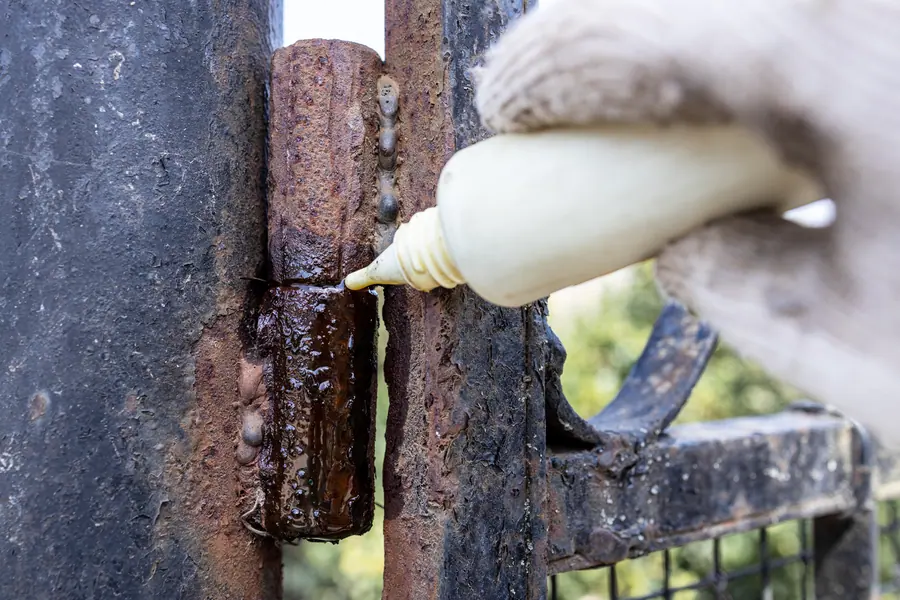
The "before" image shows a steel hinge thick with rust, being dosed with grease in an attempt to free it. The pivot is seized, the surface has flaked, and the metal around it is in no better shape. Grease can quiet a hinge like this for a while, but it can't put back the steel that corrosion has taken. A seized hinge forces the sections to twist instead of fold, and something else gives.
The repair illustrated is hardware replacement — old hinges removed one at a time and new plated steel hinges installed with fresh fasteners.
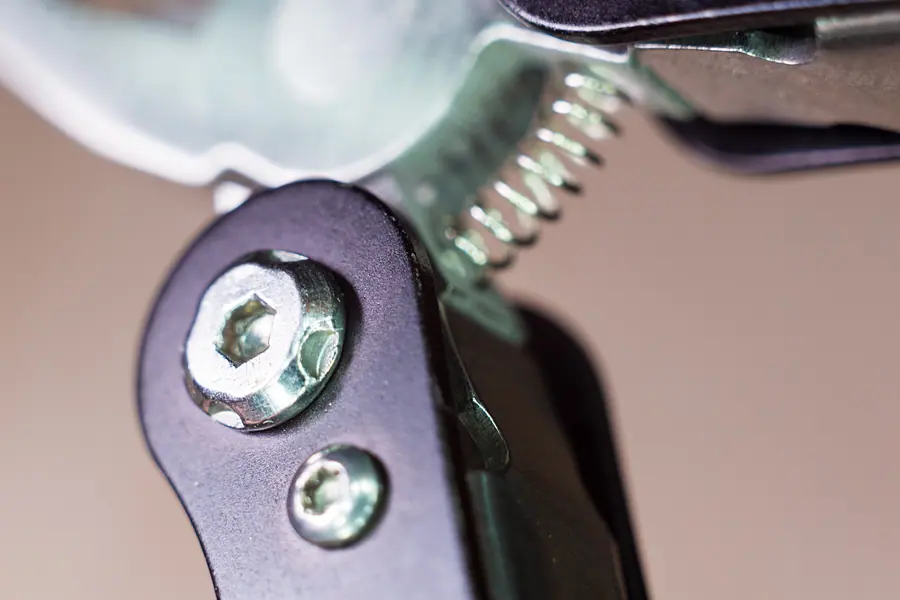
The "after" image shows clean, bright zinc-plated hardware with crisp edges and tight screws. The plating is what protects it from the damp, salty air that ruined the old set. On the door, new hinges mean each joint opens and closes freely, the sections stay in line, and the creaks and pops that came with every cycle are gone.
Illustrative exampleThese two photographs are licensed reference images chosen to show the kind of change this service makes. They are not a record of one specific Delafield Garage Door job.
Hinges and Wisconsin weather
Two things about our climate are hard on hinges: moisture and movement.
Moisture. A garage in winter is a wet place. Snow melts off the car, humidity rises, and it condenses on the coldest surface around — which is the steel on the inside of the garage door. Hinges, being bare or lightly plated steel with a pivot that traps water, start to rust at the knuckle. The lowest hinges, nearest the salt spray from tires, go first.
Movement. A steel door expands in summer heat and contracts in deep cold. Wood framing around it does the opposite with humidity. All that seasonal shifting works the fasteners loose. A hinge screw that was snug in September can be a quarter-turn slack by February, and a loose hinge fatigues quickly.
Cold makes lubricant sluggish as well, so pivots that were merely dry in the fall become stiff in January and start to complain.
The remedies are simple. A drop of garage-door lubricant on each pivot in the fall. A check of the fasteners once a year. And when hinges are replaced, plated or galvanized ones in a sensible gauge.
Can you do this yourself?
Center hinges and numbered end hinges can be changed by a careful homeowner, one at a time, with the door closed. If you're comfortable with a socket set, it's a reasonable job.
What we'd ask you to leave alone are the bottom fixtures and anything attached to a cable or spring. And if you find more than a couple of cracked hinges, it's worth having us look, because that pattern points to a door that's flexing or binding for a reason.
Having a technician do it also means the numbering and gauge will be right, stripped holes will be properly dealt with, and the rollers and track get checked at the same visit.
Hinge questions
What do the numbers on garage door hinges mean?
They indicate position. Each higher number holds the roller slightly further from the door to follow the slope of the track. Number 1 goes at the bottom joint and also serves as the center hinge.
Is a cracked hinge dangerous?
It can be. If a hinge fails completely, two sections can separate at that point, and on an end hinge the roller can come out of the track. It's best replaced promptly.
Should all hinges be replaced at once?
Not necessarily. We replace those that are cracked, bent or worn, and recommend a full set only when wear is widespread or you're upgrading the gauge.
Why do my hinges keep cracking?
Usually because the door is flexing — often a wide door without enough struts — or because it's out of balance or the opener force is set too high.
Do hinges need lubricating?
Yes. A small amount of garage-door lubricant on each pivot point twice a year keeps them moving freely and slows rust.
How long does hinge replacement take?
A few hinges take well under an hour. A complete set on a double door is a little longer.