Recognizing an extension spring system
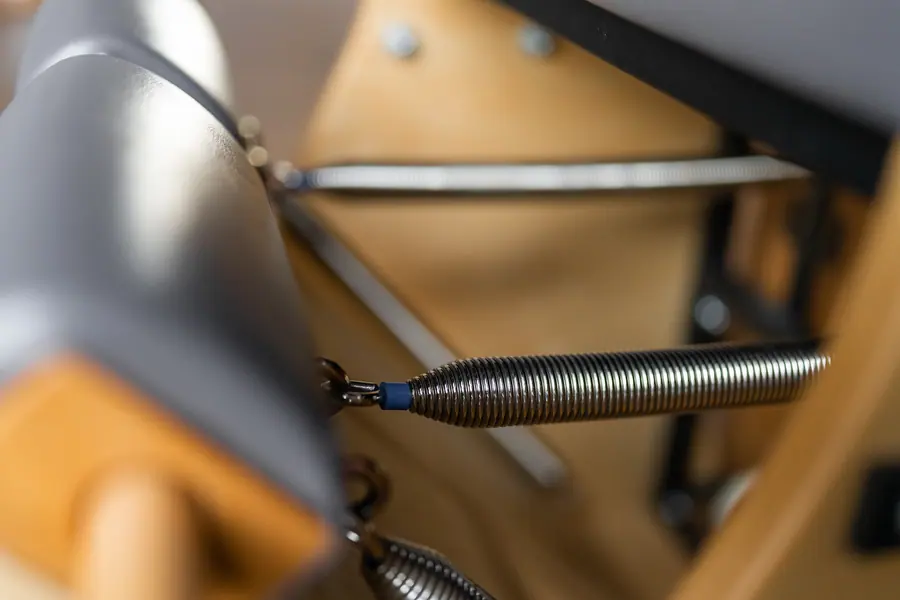
Extension springs are easy to spot. Open the garage and look at the horizontal tracks that run back along the ceiling. Above or beside each one you'll see a long coil spring, one on each side of the door, anchored at the back to a bracket and attached at the front to a pulley. A cable runs from the bottom corner of the door, up over a fixed pulley by the header, back through the pulley on the spring, and forward again to an adjustable anchor.
When the door closes, it pulls the cables, the cables stretch the springs. When it opens, the springs contract and pull the door up. Simple, compact and cheap to build, which is why they were installed to millions of single-car doors and many older double doors.
You'll find them all over the older parts of Delafield, Hartland and Waukesha, especially in detached garages and anywhere headroom above the door is tight.
How they differ from torsion springs
- Where they sit
- Extension springs run alongside the horizontal tracks. Torsion springs mount on a shaft above the door.
- How they work
- Extension springs stretch. Torsion springs twist.
- Parts count
- Extension systems have more moving parts: two springs, four pulleys, cables and anchors.
- Smoothness
- Extension doors tend to move with a little more bounce. Torsion systems are steadier.
- Lifespan
- Both are typically rated around 10,000 cycles as standard, though extension systems wear their pulleys and cables faster.
- When they break
- A torsion spring stays on its shaft. An extension spring without a safety cable can fly loose.
- Space needed
- Extension systems need less headroom, which is why they persist in low garages.
Safety cables: the part too many doors are missing
An extension spring under load is a stretched length of steel storing a great deal of energy. When one snaps, the pieces want to go somewhere fast. A safety cable is a plain steel cable threaded through the center of the spring and fixed at both ends, so that if the spring breaks, the fragments stay on the cable instead of crossing the garage.
They've been standard on new installations for decades. Even so, we still find older doors without them, or with cables that were removed during a previous repair and never put back.
What we replace
Extension springs are always replaced as a pair. They've done the same work for the same time, and a new spring on one side with an old one on the other will pull the door unevenly.
Alongside the springs, we look hard at the rest of the system, because it wears as a set.
- Pulleys (sheaves): the bearings wear, the wheel wobbles and the cable starts to rub the fork. Worn pulleys are a common cause of frayed cables and noisy doors.
- Lift cables: checked for broken strands, especially where they pass over the pulleys.
- Safety cables: installed if missing, replaced if damaged.
- S-hooks and anchors: the adjustment hardware at the front of the track.
- Rear brackets: the fixing that holds the back of the spring to the track hanger.
Choosing the right springs
Extension springs are rated by the door weight they lift. Many are color-coded with a paint dab on the end according to an industry standard, so a spring marked for 140 pounds is intended for a door of that weight, shared between the pair.
As with torsion springs, we check the door's actual weight. A previous owner may have added insulation or swapped a panel, and the color on a twenty-year-old spring isn't always legible anyway.
The simplest type. The end of the wire forms an open hook. Easy to install, but the loop is the weak point.
Two coils form the end loop, making it considerably stronger. A good upgrade for little extra cost.
A separate steel clip takes the load instead of the wire itself. The most durable option and our preference on heavier doors.
Replacing extension springs: the steps
- Open the door fullyUnlike torsion work, extension springs are changed with the door up, where they're at minimum tension.
- Secure itThe door is clamped or propped so it cannot come down, and the opener is disconnected.
- Remove the old springs and pulleysCables are unhooked, springs taken off their rear brackets, pulleys removed.
- Fit new pulleys and springsNew sheaves, new springs, safety cables threaded through and anchored.
- Route and adjust the cablesCables go back over the pulleys and are set so both sides carry equal tension.
- Lower and balanceThe door is brought down and tested by hand at several heights. Tension is adjusted at the S-hook or cable clip until the door stays put and sits level.
- Lubricate and testPulleys and rollers are lubricated, the opener reconnected and the safety reverse checked.
Should you convert to torsion?
We're asked this often, and the fair answer is: sometimes.
A torsion conversion replaces the side-mounted springs, pulleys and long cables with a shaft, drums and one or two torsion springs above the door. The door runs more smoothly, there are fewer parts to wear, and the system is easier to keep balanced.
It makes most sense when:
- The door is a heavier double door that never quite balances on extension springs
- Pulleys and cables have needed repeated attention
- A new opener is being installed and you'd like quieter, steadier travel
- There's enough headroom above the door for the shaft — usually about a foot
It makes less sense when headroom is very tight, when the door is a light single that's working well, or when the door itself is near the end of its life. We'll give you both prices and an honest view.
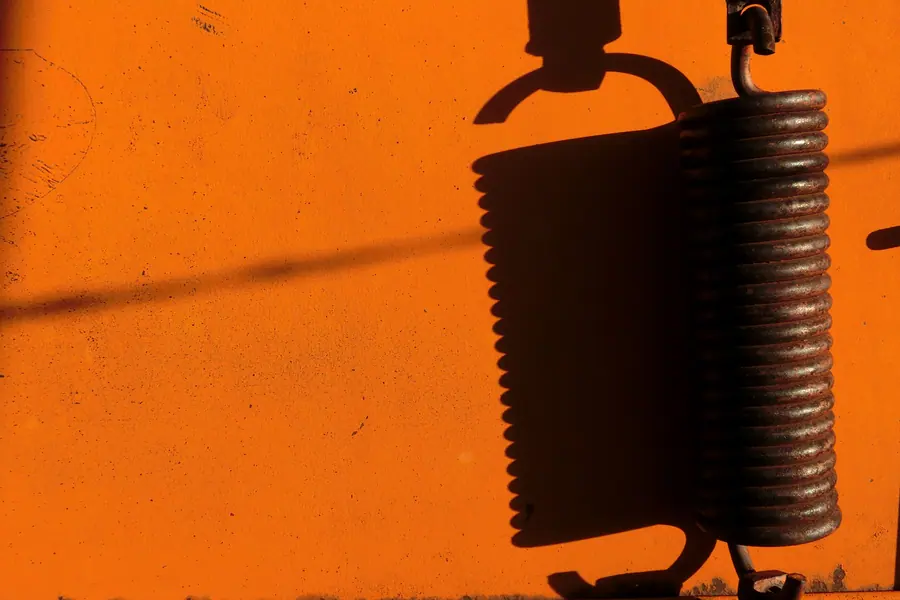
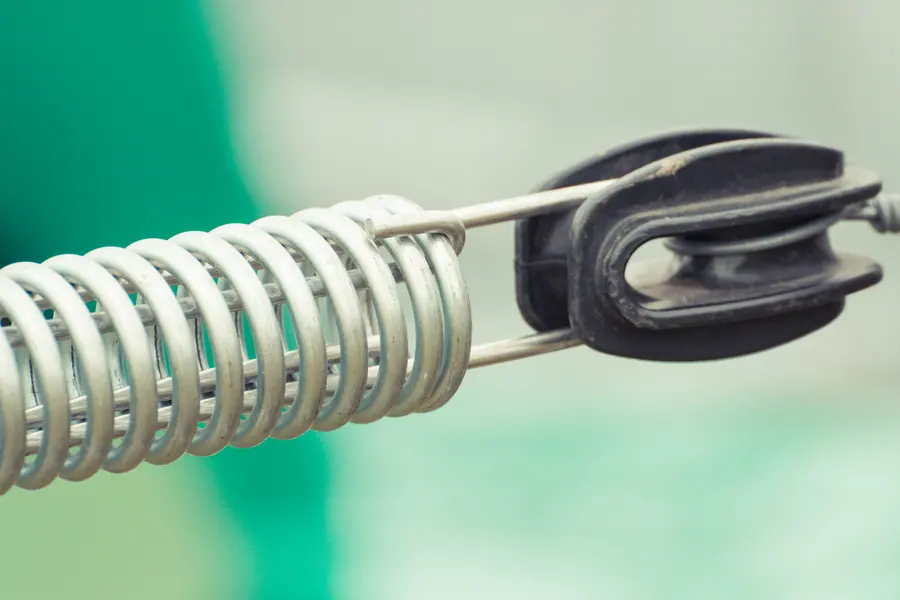 BEFOREAFTER
Before & after
A rusted extension spring replaced with a new spring and pulley
The "before" image shows an extension spring that has plainly had enough. The coils are brown with rust, the end loop is corroded, and the steel around its mounting point is in the same condition. Springs in this state lose strength unevenly, so one side of the door starts to lag behind the other, and the end loops are prone to snapping without warning.
The repair illustrated is a full extension-spring service: both springs replaced as a matched pair, new pulleys installed, and the cables rerouted and adjusted.
The "after" image shows a new spring with bright, evenly spaced coils connected to a clean pulley. What the picture can't show is the safety cable threaded through it and the equal tension on both sides of the door. In daily use that means a door that rises level, stays where it's left, and runs with far less rattle from the hardware overhead.
Illustrative exampleThese two photographs are licensed reference images chosen to show the kind of change this service makes. They are not a record of one specific Delafield Garage Door job.
Extension springs through a Lake Country winter
Extension systems are a little more exposed to our climate than torsion systems, for a simple reason: more of their parts are small, moving and unsealed.
Pulleys are the weak link in the cold. Their bearings carry a thin film of grease that stiffens at low temperatures. A pulley that was merely worn in October can seize in January, and a seized pulley saws through its cable.
The springs themselves hang in the coldest air in the garage, up near the uninsulated ceiling of a detached building. Condensation forms on them during thaws and freezes again overnight, which encourages rust at the end loops where stress is highest.
Detached garages around town, many of them unheated and decades old, are where we see the most winter failures. A check before the cold arrives — springs, pulleys, cables and those safety cables — is time well spent.
Why not do it yourself?
Extension springs are less dangerous to change than torsion springs because the work is done with the door open and the springs relaxed. That's led plenty of people to try it, and some manage fine.
The risks are still real. The door has to be reliably secured in the open position; if it comes down while a spring is disconnected, there's nothing to slow it. Cables have to be routed correctly through the pulleys or the door will bind. And the balance has to be set evenly, or the door will rack in the opening and wear its rollers and track.
Then there's diagnosis. A broken spring is often the result of a worn pulley or a mismatched pair, and swapping the spring alone doesn't cure the cause.
Extension spring questions
How do I know if I have extension or torsion springs?
Extension springs run along the horizontal tracks on each side of the door. Torsion springs sit on a bar above the door opening.
Do both extension springs need replacing at once?
Yes. They wear together and need to be matched to keep the door level and balanced.
What are safety cables and do I need them?
They're cables that run through each extension spring to contain it if it breaks. Every extension system should have them.
How long do extension springs last?
Standard springs are rated for about 10,000 cycles — typically seven to ten years of normal household use.
Is converting to torsion springs expensive?
It costs more than a like-for-like spring change because it adds a shaft, drums and bearings. We'll price both so you can compare.
Why is my door crooked when it opens?
On an extension system that usually means one spring is weaker than the other, a cable has stretched, or a pulley is failing. It should be looked at before the uneven load damages the track or sections.