What rollers do
Along each edge of your garage door there's a row of small wheels on steel stems. The stems slide into the hinges between sections; the wheels sit inside the C-shaped track. As the door rises, the rollers carry it up the vertical track, around the curve and back along the ceiling.
A standard seven-foot sectional door has ten rollers, five per side. Taller doors have twelve or more. Each one spins every time the door moves and takes a sideways load as the door changes direction through the curve.
They're simple parts, and inexpensive ones. But when they wear, the effect on the whole door is out of all proportion to their size.
Signs your rollers are worn
- Grinding or rattling
- Metal-on-metal noise as the door travels, often worst through the curved section of track.
- Squealing
- A high-pitched squeak that lubricant quiets for a week before it returns. The bearing is failing.
- Shaking and jerking
- The door shudders as it moves because one or more rollers is dragging instead of turning.
- Visible wobble
- The wheel tilts on its stem when you watch it pass. The bearing race is worn out.
- Flat spots or chips
- Nylon wheels that have seized develop flats. Steel wheels wear grooves.
- A roller out of the track
- A badly worn roller can pop out, especially at the curve.
- Opener straining
- The motor hums louder or reverses for no clear reason, because the door has become harder to move.
A quick test: with the door closed, grab a roller and try to rock the wheel on its stem. A little play is normal. If it tilts noticeably, clicks, or you can feel roughness when you spin it, it's due.
The types of roller
This is where a small upgrade pays off.
The cheapest roller made, installed by many builders. A plain plastic wheel on a steel pin. They wear quickly and are usually the reason a five-year-old door already sounds old.
A steel wheel with exposed ball bearings. Strong and long-lived, but loud, and the bearings need regular lubrication or they rust.
A nylon tire over a steel ball-bearing hub. Much quieter than steel. Bearings still need occasional lubricant.
The roller we install most. A nylon wheel on a sealed precision bearing, typically with ten to thirteen balls. Quiet, smooth, no maintenance at the wheel, and rated for many tens of thousands of cycles.
Thicker stems and larger wheels for heavy wood doors, commercial doors and wide doors with double-end hinges.
For a home in this climate, sealed nylon rollers are our standing recommendation. The seal keeps road salt and grit out of the bearing, the nylon doesn't rust, and they stay quiet when it's cold.
What new rollers change
Noise. This is the one people notice immediately. A door on worn steel rollers can be heard through the whole house. The same door on sealed nylon rollers often drops to a soft rumble.
Smoothness. With every roller turning freely, the door glides instead of juddering. Sections stay aligned and stop slapping against the track.
Opener life. Rolling resistance drops, sometimes dramatically. The opener draws less current, runs cooler and its gears last longer.
Track life. A seized roller drags along the track and wears a groove in it. Free-spinning rollers leave the track alone.
Safety. Rollers in good condition stay in the track. Worn ones are a common cause of doors coming off.
How we replace rollers
It looks like a job of pulling a wheel out and pushing one in. Most of it is, with two important exceptions.
- Inspect firstWe check all the rollers, the hinges they sit in and the track. Roller wear often points to a track alignment problem that should be corrected at the same visit.
- Secure the doorThe opener is disconnected and the door is clamped so it can't move.
- Replace the upper rollersOn the middle hinges, the hinge is unbolted from the section, the old roller slides out, the new one goes in and the hinge is refastened.
- Deal with the top rollersThe top fixtures are adjustable. They're removed, installed with new rollers and reset so the top section sits snug against the header seal.
- Handle the bottom rollers with careThese sit in the bottom brackets, which also anchor the lift cables and carry the spring tension. They must not be unbolted with the springs wound. We either release the tension first or use a method that opens the track without disturbing the bracket.
- Check the hingesAny that are cracked or worn at the roller sleeve are replaced.
- Lubricate and testHinges and springs are lubricated, the door run by hand, and the opener's force setting rechecked, since the door now moves more freely.
A full set on a standard door is usually done in under an hour.
While the rollers are out
Because every hinge is handled during the job, it's the right time to look closely at them. The sleeve that holds the roller stem wears oval over time, letting the roller rattle no matter how new it is. Cracks start at the knuckle on center hinges of wider doors. Replacing a worn hinge at this point adds a couple of minutes and a few dollars.
We'll also check the track for flat spots, dents and loose brackets, and tighten every fastener we touch. Loose hardware is the second biggest source of door noise after the rollers themselves.
Common mistakes with rollers
- Greasing the track. It doesn't help the rollers and it collects grit that grinds them down. Tracks should be clean and dry.
- Lubricating nylon wheels. The lubricant belongs in the bearing, not on the tire.
- Replacing only the noisy one. Rollers wear together. One new roller among nine worn ones won't change much.
- Fitting short-stem rollers in hinges that need long stems, so the roller can work its way out.
- Unbolting the bottom bracket. We've mentioned it already; it's worth repeating.

 BEFOREAFTER
Before & after
A worn, rusted wheel compared with new sealed-bearing rollers
The "before" image shows an old wheel on a rusted bracket, pitted and worn from years of exposure. It's a fair stand-in for what we pull out of neglected doors: bearings dry and rough, the wheel loose on its axle, corrosion on every surface. A roller in that condition doesn't roll so much as scrape, and it passes every vibration straight into the door and the track.
The work illustrated is a full roller replacement — every roller on the door swapped for new sealed-bearing units, with worn hinges changed at the same time.
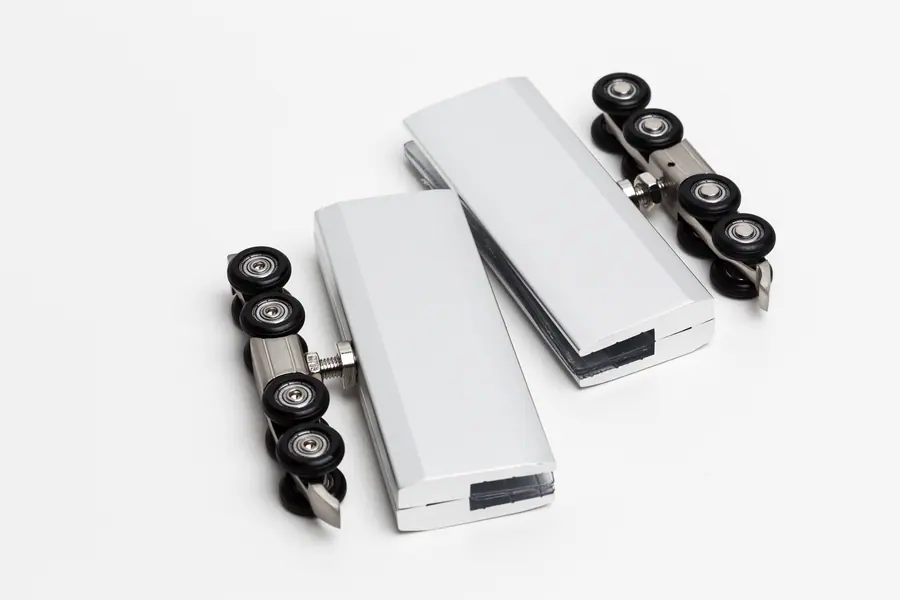
The "after" image shows new roller assemblies with clean housings and sealed bearings. Nothing about them needs explaining; they simply turn freely and quietly, and will keep doing so for years without attention. On the door, the difference is heard before it's seen. Travel is smooth, the rattle is gone, and the opener no longer has to push through resistance at every wheel.
Illustrative exampleThese two photographs are licensed reference images chosen to show the kind of change this service makes. They are not a record of one specific Delafield Garage Door job.
Rollers in the cold
Winter is hard on roller bearings, and the reasons are specific to places like ours.
Open bearings rely on grease or oil. At ten below, that lubricant thickens to something closer to wax, and a bearing that spun freely in summer drags. If it has any wear at all, the cold shows it up. That's why so many doors start screeching in January.
Then there's salt. Slush thrown up from tires lands on the lowest rollers and the bottom of the vertical track. Brine gets into open bearings, washes out the lubricant and starts rust. The bottom two rollers on each side are nearly always the first to fail on Wisconsin doors for exactly this reason.
Sealed nylon rollers deal with both problems. The bearing is closed off from moisture and grit, the factory lubricant is retained, and nylon doesn't corrode or stiffen the way cheap plastic does.
If your door is noticeably louder in winter than in summer, the rollers are the first place we'd look.
Why have a technician do it
The middle rollers are within reach of a capable homeowner. The top and bottom ones aren't as simple. Top fixtures need resetting correctly or the door won't seal at the header. Bottom brackets are under spring load and are the source of some nasty injuries when unbolted by the unwary.
A technician also brings context. If rollers have worn unusually fast, something caused it: track out of plumb, a bent section, a door out of balance. Replacing the rollers without addressing that just starts the clock again.
Roller questions
How long do garage door rollers last?
Basic plastic rollers may last only a few years. Sealed nylon ball-bearing rollers are commonly rated for tens of thousands of cycles — ten to twenty years in a typical home.
Will new rollers make my door quieter?
Almost always, and often dramatically. Rollers are the main source of travel noise on most doors.
Should I replace all the rollers at once?
Yes. They wear at similar rates, the cost per roller is low, and replacing the set gives a consistent, lasting result.
Do nylon rollers need lubricating?
Sealed-bearing rollers don't. Open-bearing nylon rollers benefit from a drop of lubricant in the bearing twice a year.
Can I replace the bottom rollers myself?
We don't recommend it. The bottom bracket holds the lift cable under spring tension and must not be removed without releasing that tension first.
How many rollers does my door have?
Most seven-foot doors have ten. Eight-foot doors have twelve. Wide or heavy doors may have double rollers at each hinge.