Three pieces of steel that have to agree
Each side of a garage door runs in a track made of three parts. The vertical track is fixed to the door jamb. The radius, or curve, turns the door from vertical to horizontal. The horizontal track runs back toward the rear of the garage, hung from the ceiling or joists by angle-iron hangers.
For the door to travel freely, those pieces have to line up with each other, and the left side has to mirror the right. The vertical tracks must be plumb and the same distance from the door along their full height. The horizontals must be level with each other, square to the opening and parallel. Get any of that wrong and the rollers bind.
Residential track is usually two inches wide and made from fairly light-gauge galvanized steel. It's strong enough for the job, but it will bend if hit, and it will shift if its fasteners loosen. Both happen more often than you'd think.
How track problems show themselves
The edge of the door or the roller stems scrape the track on the way up or down, sometimes leaving shiny wear marks.
The door slows or sticks at the same height every time, then frees up. There's a kink, dent or tight spot there.
Rollers that sit loose in the track on one side and tight on the other mean the tracks aren't parallel.
Often low down on the vertical track, at bumper height.
As it rises, the door moves toward one jamb. The tracks are out of plumb or the spacing is uneven.
The ceiling tracks sway or bounce when the door runs. The hangers are loose or inadequate.
With the door closed, it's tight to the stop at the top and standing off at the bottom, or the reverse.
What knocks track out of line
- Vehicle impact. A bumper, a mirror or a trailer nudging the vertical track is the classic cause. It doesn't take much.
- Loose lag screws. The track brackets are fastened to the jamb with lag screws that work loose over years of vibration.
- Failing hangers. Thin perforated strap or a single angle with no bracing lets the horizontal track sway and sag.
- The building moving. Framing dries, foundations settle and frost lifts slabs. The opening the track was set to isn't quite the same shape any more.
- A previous off-track incident. When a door comes out of its track, the track is usually bent in the process.
- Worn rollers. A seized roller drags and gouges the track, creating a rough spot that grabs every roller after it.
- Poor original installation. We see plenty of track that was never plumb to begin with.
Repair or replace the track?
It depends on the damage, and we'll tell you which applies.
When adjustment is enough
If the track is sound but has shifted, the fix is realignment. Brackets are loosened, the track is set plumb and at the correct spacing from the door, and everything is tightened into solid wood. Horizontal tracks are leveled and squared, and the hangers are stiffened if they need it.
When straightening works
Minor bends and flattened edges can often be dressed back into shape. The test is whether a roller passes the spot smoothly afterward. If it does, the track can stay.
When replacement is the right call
Track that's creased, torn at a bracket, badly rusted or kinked through the radius should be replaced. Steel that has been sharply bent is weakened, and a curve that's out of shape will never guide rollers properly. Track is sold in matched sets for a given door height and radius, and we replace both sides where the profile needs to match.
How we go about it
- Disconnect and observeThe opener is released and the door run by hand while we watch each roller through its travel.
- MeasureA level on the vertical tracks, a tape between the horizontals at front and back, and a check of the gap between track and door edge at several heights.
- Find the causeBent section, loose bracket, sagging hanger, shifted jamb — the fix depends on the reason.
- Correct the vertical tracksBrackets are reset so the track is plumb and sits about half an inch off the door edge, with the door just touching the weatherstrip when closed.
- Correct the horizontalsLeveled side to side, given a slight rise toward the back, squared to the opening and fastened to hangers that won't flex.
- Straighten or replace damaged piecesDents dressed out where practical; creased or cracked sections swapped.
- Check the rollers and hingesTrack faults usually leave their mark on the rollers, so those are inspected too.
- Test under powerThe opener is reconnected and the door run through several full cycles.
Fastening matters
A track is only as true as its fixings. A few details we pay attention to:
- Jamb brackets
- Fastened with lag screws into the framing behind the jamb, not into trim or drywall alone.
- Flag brackets
- The plates that join vertical track to horizontal. They carry a lot of load and must be solidly fixed at the top of the jamb.
- Rear hangers
- Punched angle iron of adequate gauge, fastened to joists or blocking. Perforated strap is not enough.
- Sway bracing
- A diagonal brace on each rear hanger stops the horizontal track swinging side to side.
- Track bolts
- Round-headed, with the heads inside the track so rollers pass over them cleanly.
- Splices
- Where vertical meets radius, the joint must be flush. A lip there will catch every roller.
What happens if track problems are ignored
A door that rubs is a door wearing something out. The rollers go first, then the hinges as they're twisted by the binding. The opener works against the friction and wears its drive gear or trips its force limit. The door's own sections can crack along the edges where they scrape.
The worst outcome is the door leaving the track altogether. A roller that climbs out at a bend lets that corner of the door swing free, and the rest can follow. At that point it's a safety problem and a much larger repair. See our page on off-track doors for what that involves.
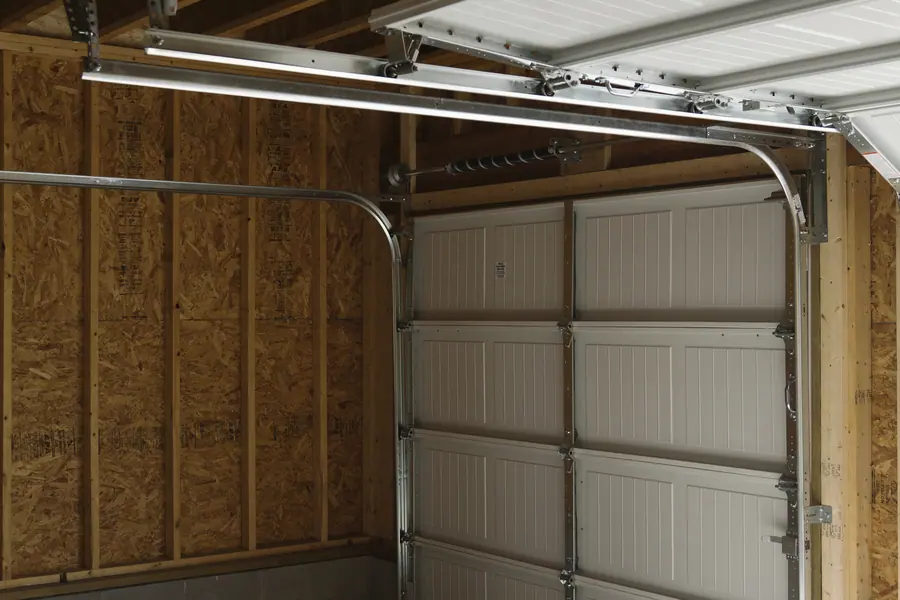
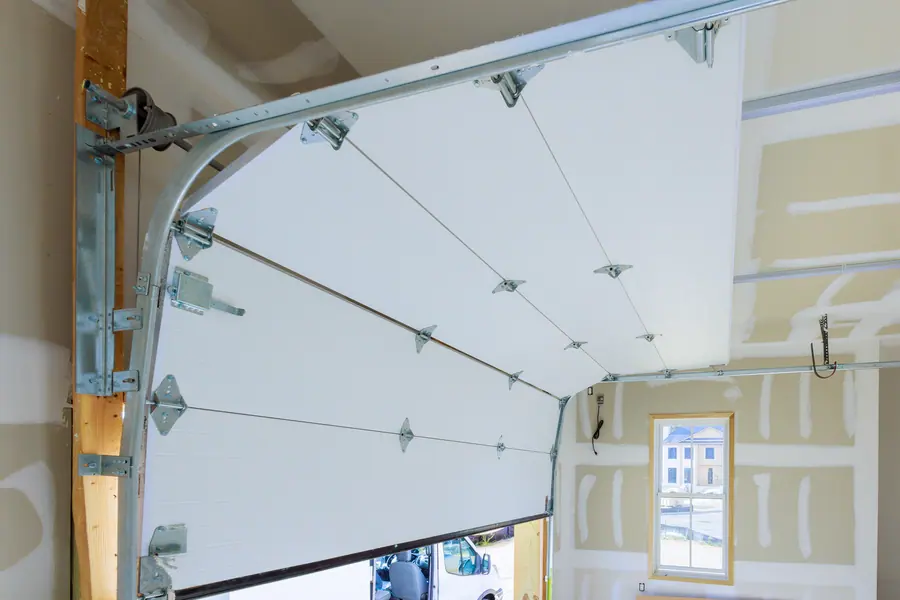 BEFOREAFTER
Before & after
Worn track on bare framing compared with straight, well-braced track
The "before" image shows the inside of an older garage with open stud walls and a door hung on well-used track. The framing is unfinished, the brackets have plainly been there a long time, and the horizontal run depends on minimal support. It's typical of garages where the track has slowly drifted: nothing dramatic, just years of vibration loosening the fixings a little at a time.
The work illustrated is a full track service. The door is supported, old or damaged track is removed, and a new set is installed — plumb on the jambs, level and square overhead, and braced so it can't sway.
In the "after" image the track is bright and straight, the curve is smooth, and each bracket sits flat against solid framing. The door's inner face shows evenly spaced hinges and rollers seated properly in the channel. What this gives the owner is a door that travels in a straight line, stays quiet, and puts no sideways strain on its rollers, hinges or opener.
Illustrative exampleThese two photographs are licensed reference images chosen to show the kind of change this service makes. They are not a record of one specific Delafield Garage Door job.
Track, frost and the Wisconsin garage
Track is fixed to the building, and in this part of the state buildings move with the seasons.
Frost heave is the main culprit. When the ground under a slab or a shallow footing freezes, it lifts — rarely evenly. A detached garage on a floating slab can rise at one corner by half an inch or more in a hard winter and settle back in spring. The door opening racks slightly each time, and the track fixed to it goes along for the ride. Doors that work in summer and bind in February are often telling you exactly this.
Wood framing shrinks in our dry winters and swells in humid summers. Lag screws that were tight in August can be a little slack by January.
Salt attacks the bottom of the vertical tracks. Slush thrown from tires sits in the channel, and after enough winters the steel thins and flakes at floor level.
Ice can build inside the lower track where meltwater runs down the door. Rollers ride up over it and the door binds.
We allow for all of this when we set track here: solid fixings into framing, proper bracing, a little tolerance where the building is known to move, and a recommendation to rinse the lower tracks every spring.
Why not just tap it back yourself?
A light tap with a mallet to free a tight spot is fair game. Beyond that, track adjustment gets tricky quickly.
Loosening the brackets changes the relationship between the door and the springs' cables. Move the top of the vertical track and you alter how the door meets the header. Shift the horizontals and the cable drums may no longer line up with the door edge. It's easy to cure a rub in one place and create a trash cand in another.
There are safety limits too. The flag brackets at the top of the vertical track and the bottom fixtures on the door are tied to the spring system. They shouldn't be unbolted with the springs under tension.
Track repair questions
Can bent garage door track be straightened?
Minor bends often can. Sharp creases, tears or damage in the curved section usually mean the track should be replaced, because the steel is weakened.
Why does my door rub on one side?
The tracks are probably out of plumb or unevenly spaced, or the door itself has shifted because of a cable or roller issue. We check all three.
Is it safe to use the door with a bent track?
If it still runs freely, light use until the repair is usually fine. If it's binding or a roller is close to coming out, stop using it.
Should I lubricate the tracks?
No. Tracks should be clean and dry. Lubricate the roller bearings, hinges and springs instead.
How long does a track repair take?
Realignment is typically under an hour. Replacing track on both sides takes longer, as the door has to be supported while the old track comes out.
My door only sticks in winter. Is that the track?
Quite possibly. Frost movement in the slab or framing can pull the track out of line seasonally. We can adjust it with that in mind.