How to know it's time
Openers don't usually die in a single dramatic moment. They fade. Here are the signs we treat as a nudge toward replacement.
Past twelve to fifteen years, parts get scarce and each repair buys less time.
Openers made before 1993 weren't required to have them. That's a safety gap you can't patch.
Old remotes with internal DIP switches send the same code every time. It can be copied with cheap equipment.
A chain drive that rattles the bedroom above. Newer belt and DC units are a different experience.
Random reversals, refusing to close, opening on its own. Often a failing logic board.
A gear last year, a capacitor this year, a sensor next. The costs add up quickly.
When the board or gear kit is no longer made, the decision is made for you.
No battery backup, no phone control, no automatic close.
A heavier or taller door than the opener was specified for.
If the fault is small and the unit is fairly young, we'll repair it. We only suggest replacement when the numbers support it.
What's improved since your opener was made
If your current unit is fifteen or twenty years old, quite a lot has changed.
Safety. Photo-eyes and force-sensing reversal are now universal and far more refined. Some units add a second layer of monitoring on the motor itself.
Security. Rolling-code radio means the signal changes every time. Many openers also lock the door mechanically when it's down.
Quiet. DC motors and belt drives have transformed how openers sound. Soft start and stop removes the bang at each end of travel.
Outage operation. Integrated batteries keep the door working through an outage.
Connectivity. Wi-Fi is built into most mid-range units. You can check the door from anywhere, get an alert if it's left open, and let someone in remotely.
Lighting. Integrated LED panels light the whole garage and never need a bulb.
Efficiency. Standby power draw is a fraction of what it was.
Matching a new opener to your garage
You're not obliged to replace like with like. This is a good moment to think about how you use the garage.
- Bedroom or office above the garage
- Belt drive with a DC motor, or a wall-mount unit, plus vibration isolators. Quiet is the priority.
- Detached garage
- A chain drive is perfectly reasonable and saves money. Add Wi-Fi if you'd like to check the door from the house.
- High ceilings or overhead storage
- A wall-mount jackshaft opener keeps the ceiling clear.
- Heavy wood or oversized door
- A higher-rated motor and a heavy-duty rail.
- Frequent power outages
- Battery backup, without question.
- Often forget to close it
- Timer-to-close and phone alerts.
- Deliveries or guests while you're out
- Smart control with temporary access.
- Older car with built-in buttons
- We'll confirm compatibility or add a bridge module.
We'll talk it through and recommend one or two units that fit, not the most expensive model on the shelf.
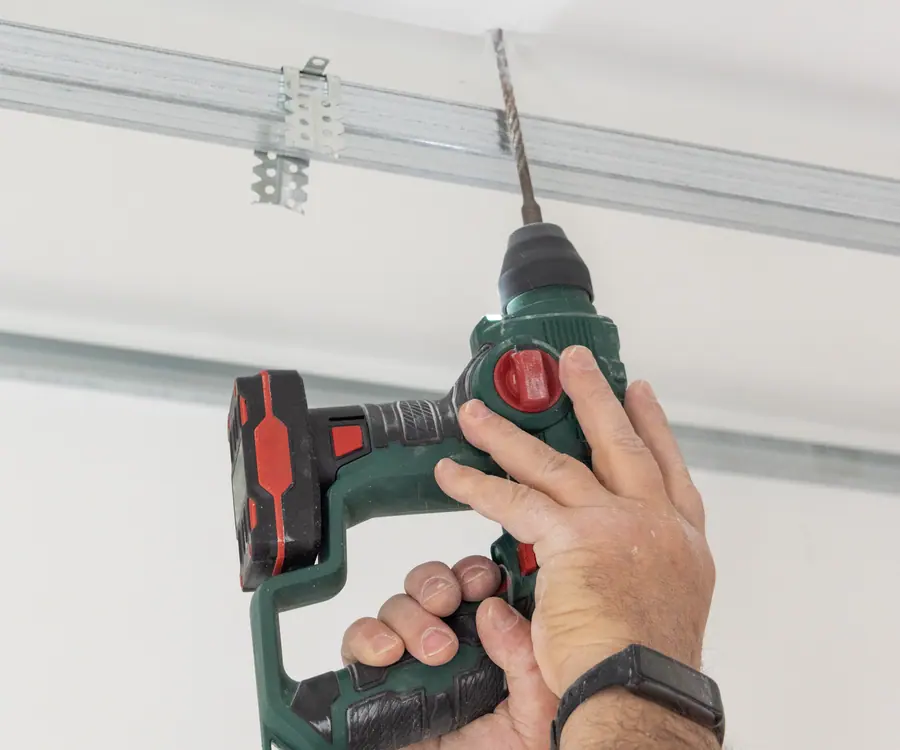
What a replacement involves
Replacing an opener is more than unbolting one and bolting up another. Done properly, it goes like this.
- Check the doorDisconnected and run by hand. Balance, rollers, hinges and springs are assessed. An opener replacement on a door that's out of balance is money wasted.
- Remove the old unitMotor, rail, header bracket, door arm, old sensors and wiring all come down.
- Inspect the mounting pointsThe header and ceiling fixings are checked. Old angle and strap are replaced, not reused.
- Reinforce the top sectionIf there's no bracket or strut, one is added.
- Install the new openerHeader bracket, rail, motor unit and arm installed and aligned.
- Fit new sensors and wall controlNew photo-eyes and new wire. We don't reuse old sensor wiring that's brittle or spliced.
- Set limits and forceAdjusted to the door, then tested for reversal with a board on the floor and with the beam broken.
- Program everythingRemotes, keypad, in-car buttons and the app.
- Remove the old equipmentIt leaves with us.
- Show you how it worksIncluding the manual release and any new features.
Most replacements are completed in a few hours.
What usually gets replaced with it
A few related items are worth doing at the same visit, because the labor overlaps.
- Photo-eyes and wiring. Always new with a new opener.
- Wall control. New units need their own, with features the old button doesn't have.
- Remotes and keypad. Old ones generally aren't compatible.
- Reinforcement bracket. If missing.
- Rollers. If they're worn, new quiet rollers make the most of a quiet opener.
- Springs. If the door is out of balance, the springs are adjusted or replaced before the opener is set.
We'll point these out and you choose what's done.
Can the old rail or sensors be reused?
People ask, hoping to save a little. Generally, no. Rails are matched to the motor unit and drive type. Sensors are specific to the brand and generation. Wall controls communicate with the logic board in ways the old ones can't. Reusing mismatched parts causes faults that are tedious to trace, and in the case of sensors, compromises safety.
The one thing that can often stay is the power outlet. If it's a two-prong or ungrounded outlet, or it's hanging loose from the ceiling box, we'll point that out so an electrician can put it right before the new unit depends on it.
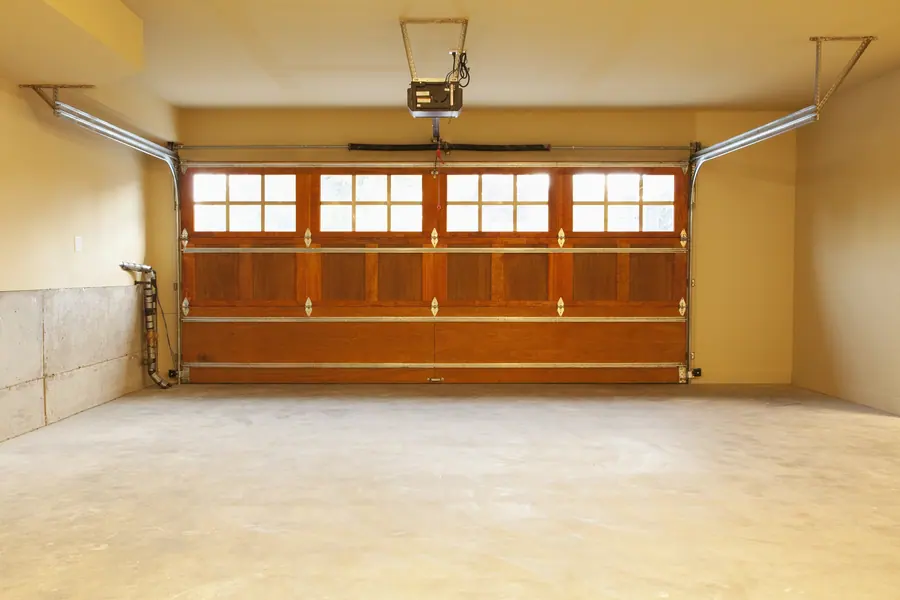
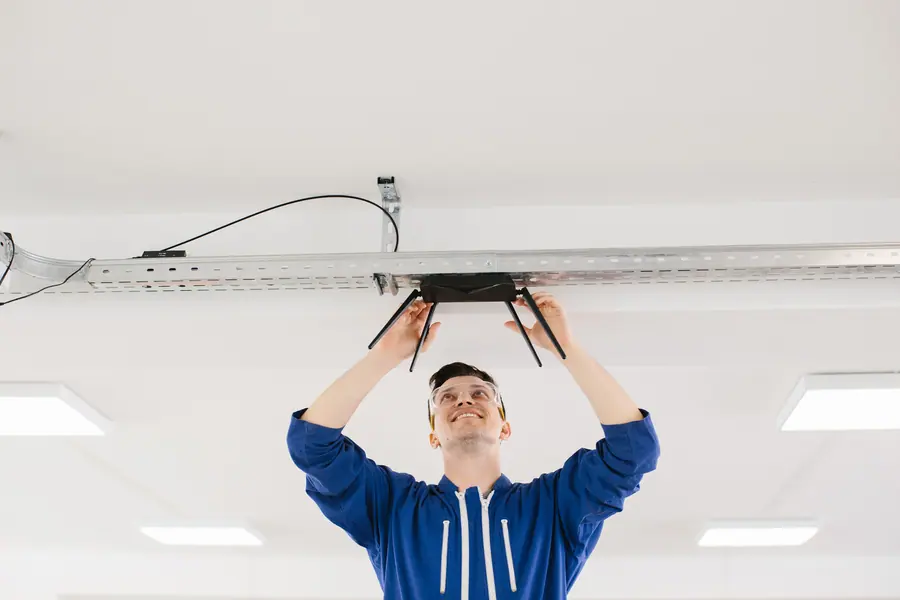 BEFOREAFTER
Before & after
A dated opener over a wood door compared with a new unit being installed
The "before" image shows the interior of an older garage: a panelled wood door, bare walls, and a dated opener hanging from the ceiling on a long rail. Units like this were built to last, and many have. But they're loud, they often predate modern sensor requirements, and their radio controls belong to another era. The mounting hardware in garages of this age has usually worked loose too.
The service illustrated is an opener replacement. The old motor, rail and wiring are removed, and a technician fits a new unit at the ceiling on fresh mounts in a clean, bright space.
The "after" image captures that moment — a compact new unit being secured overhead. For the owner, the change is felt immediately. The door moves quietly and smoothly, it reverses reliably when something's in the way, the remotes are secure, and features like battery backup and phone control come as part of the package.
Illustrative exampleThese two photographs are licensed reference images chosen to show the kind of change this service makes. They are not a record of one specific Delafield Garage Door job.
Replacement with Wisconsin in mind
Local conditions tilt a few of the choices.
Battery backup. Winter storms take the power out here most years. An opener that keeps working is more than a convenience when it's ten degrees and the car is inside.
Cold-weather reliability. DC motors and belt drives handle the cold well. We set force with enough margin for winter stiffness, then confirm the door still reverses properly.
Smart alerts. An attached garage door left open on a January night chills the house and can freeze pipes in the garage ceiling. A notification on your phone is a cheap safeguard.
Automatic close. Same reasoning. If the door closes itself after ten minutes, the heat stays in.
Surge protection. Thunderstorms and ice-related power fluctuations kill logic boards. We suggest a surge protector on the outlet.
Sensor placement. We position the receiver away from direct low sun where we can, to avoid false trips on bright winter afternoons.
Why have it done professionally
The physical swap is the easy part. What takes experience is everything around it: judging whether the door is fit to be driven, mounting into structure, reinforcing the top section, and setting force so it's safe in every season.
There's also the disposal of the old unit, the tidy routing of new wire, and someone to walk you through the app and the manual release. And if the door turns out to need a spring adjustment or a roller or two, we can do it there and then.
Opener replacement questions
How long should a garage door opener last?
Around ten to fifteen years is typical. A well-balanced, maintained door helps an opener last longer.
Can I keep my old remotes?
Usually not. New openers use different radio technology. New remotes are supplied and we'll program your car's built-in buttons where compatible.
Do I need to replace the springs too?
Only if they're worn or the door is out of balance. We check, and we won't set up a new opener on a door that isn't right.
Can I switch from a chain drive to a belt drive?
Yes. The whole rail and motor assembly is replaced, so you can choose any drive type suited to your garage.
Is a wall-mounted opener an option for my garage?
If you have a torsion spring system, a little wall space beside the door and an outlet nearby, usually yes.
How long will I be without an opener?
Only during the installation itself — typically a few hours.