Not a bigger garage door opener
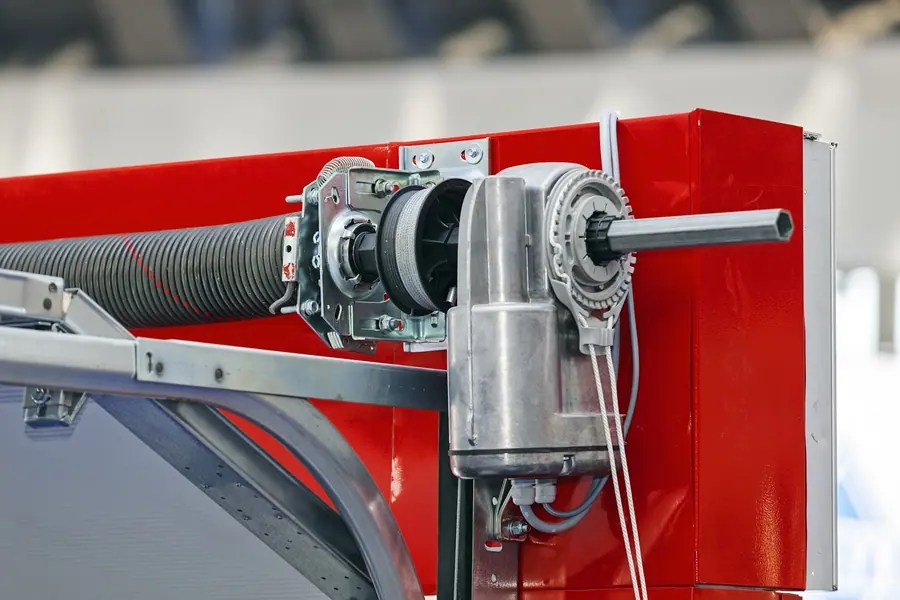
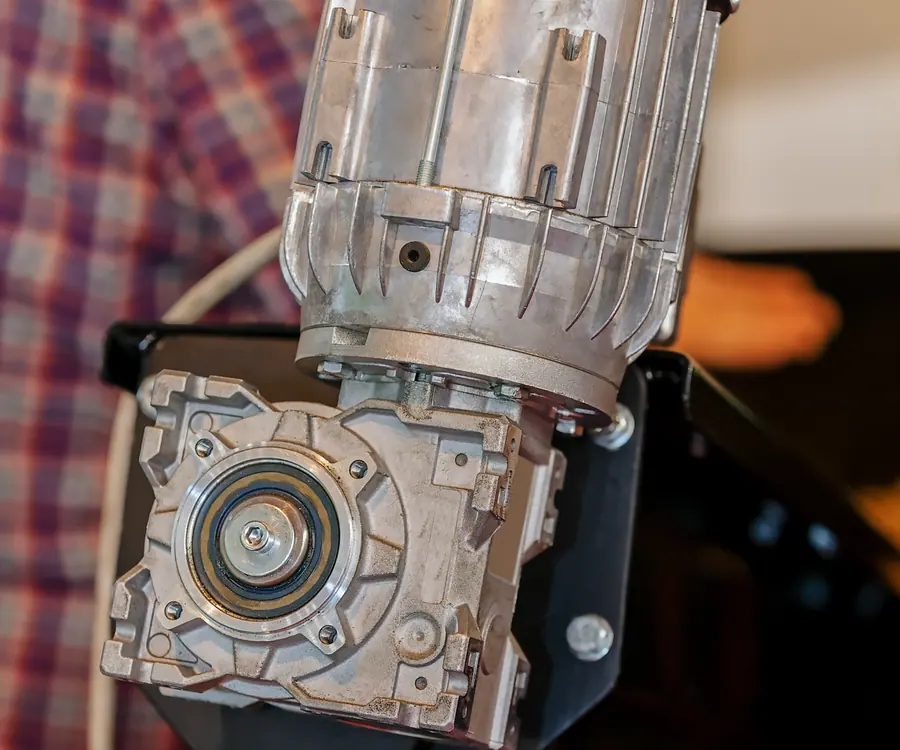
A residential opener is a consumer appliance. A commercial operator is industrial equipment. It's built around a continuous-duty or high-cycle motor, a gear reducer, a brake, a set of limit switches and a control board or contactor panel, all specified for a particular door weight and number of cycles per hour.
It also plugs into more. Three-button stations, key switches, pull cords, radio receivers, loop detectors in the pavement, card readers, timers, interlocks with dock equipment, fire alarm interfaces — and, critically, monitored safety devices that must prove they're working before the door will close on a momentary command.
That complexity is why operator faults can be puzzling. The motor's fine, but the door won't close. It runs up but not down. It works from the wall and not from the remote. Sorting that out takes a methodical approach and a meter.
Operator types
- Trolley (drawbar)
- A motor at the back drives a chain or belt along a rail, pulling the door via an arm. For standard-lift sectional doors.
- Jackshaft
- Mounted on the wall beside the door, it drives the door shaft through a chain or direct coupling. For high-lift and vertical-lift sectional doors, rolling steel doors and grilles.
- Hoist
- A jackshaft operator with a hand chain for manual operation when the power is out.
- Slide
- For horizontally sliding doors and gates.
- Direct-drive / gearhead
- Compact units mounted on the shaft itself, common on rolling doors.
- High-speed door drives
- Variable-frequency units for doors that cycle in seconds.
They're also classed by duty: light, medium, heavy and continuous. An operator that's under-rated for the door or the traffic will overheat and wear out early.
Symptoms and likely causes
No power, a tripped breaker or overload, a blown control fuse, an open interlock, or a failed transformer or board.
A failed capacitor on single-phase motors, a seized brake, a jammed door, or a lost phase on three-phase supply.
A stuck limit switch, a failed contactor or relay, or a safety device holding the close circuit open.
Almost always the safety circuit: photo-eyes blocked or misaligned, or a faulty sensing edge. By design, the operator won't close without it.
The monitored safety device isn't detected, so the operator has reverted to hold-to-close.
Limit switches out of adjustment, or a slipping clutch or brake.
Worn brake.
The door is out of balance or binding, or the motor is failing.
Broken drive chain, sheared key, stripped coupling or a disengaged clutch.
Loose wiring, a failing board, moisture in a control station, or radio interference.
Worn gear reducer, dry chain, loose sprockets or mounting bolts.
What we service
- Motors: testing windings, capacitors and bearings; replacing where needed
- Brakes: adjusting or replacing solenoid and disc brakes so the door stops and holds
- Clutches: adjusting friction clutches that protect the drive if the door jams
- Gear reducers: checking oil, seals and wear
- Drive chains, sprockets and couplings: tension, alignment and replacement
- Limit switches: rotary and electronic limits set for full open and firm close
- Control boards and contactors: diagnosis and replacement
- Transformers, fuses and overloads
- Control stations: push-buttons, key switches and pull cords
- Radio controls: receivers and transmitters
- Safety devices: photo-eyes and sensing edges, including monitored types
- Wiring: conduit, coil cords and take-up reels for edge wiring
- Manual release and hand chains: so the door can be operated in an outage
Our diagnostic process
- Lock outPower is isolated and locked before anyone touches the drive.
- Check the door firstThe operator is disconnected and the door moved by hand or chain. If it's out of balance or binding, that's the root cause and it's fixed before the operator is blamed.
- Verify powerVoltage, phase and connections at the operator.
- Read the indicatorsMany control boards have diagnostic LEDs or fault codes.
- Work through the control circuitStop circuit, interlocks, limits, safety inputs and each control station in turn.
- Test the motor and brakeElectrically and mechanically.
- Inspect the drive trainChain, sprockets, couplings, clutch and reducer.
- RepairReplace the failed component with the correct part.
- Set limits and safetyLimits adjusted, clutch set, and every safety device tested with the door in motion.
- ReportWhat failed, what was done and anything else showing wear.
Safety devices and why the door "won't close"
This is the single most common operator complaint, so it deserves its own section.
Current safety standards for commercial operators require a monitored external entrapment-protection device — typically photo-eyes across the opening or a sensing edge on the bottom of the door — if the door is to close from a single press of a button, a remote or a timer. "Monitored" means the operator checks continuously that the device is present and working.
If the eyes are knocked out of line, the edge's coil cord is damaged or a wire comes loose, the operator sees the fault and refuses to close automatically. It will usually still close if you hold the button down, as a fallback.
So when staff report that they "have to hold the button," the operator is telling you a safety device needs attention. The cure is to repair the device — never to bypass it.
Repair or replace the operator?
Commercial operators are built to be repaired, and most faults are a single component. Repair is the norm.
We'll raise replacement when the unit is old enough that boards and parts are no longer available, when it doesn't meet current safety requirements and can't be upgraded, when it's under-rated for the door or the traffic it now sees, or when the cost of a major component approaches that of a new operator.
A new operator is also an opportunity to add features: soft start and stop, timers to close, integration with access control, or a battery or hoist for outages.
 BEFOREAFTER
Before & after
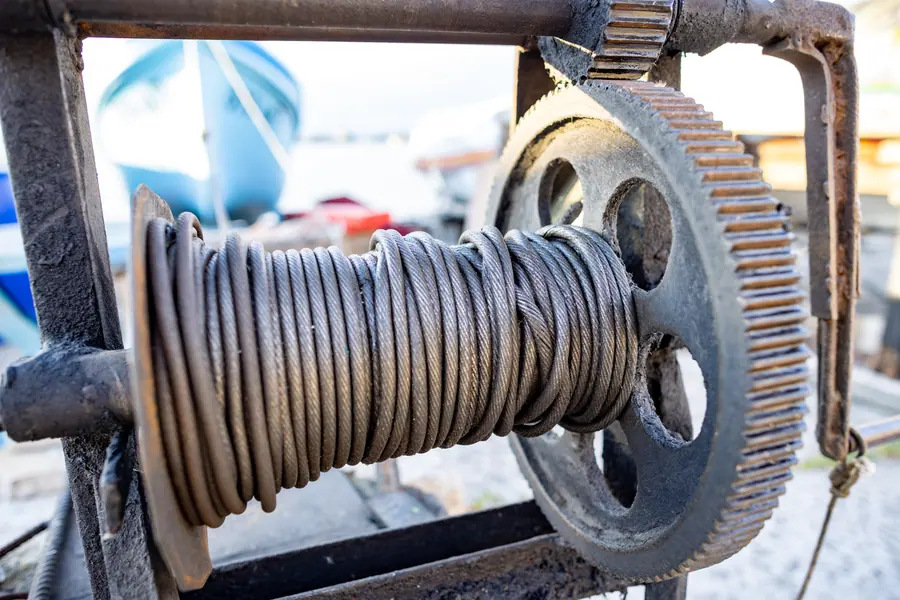
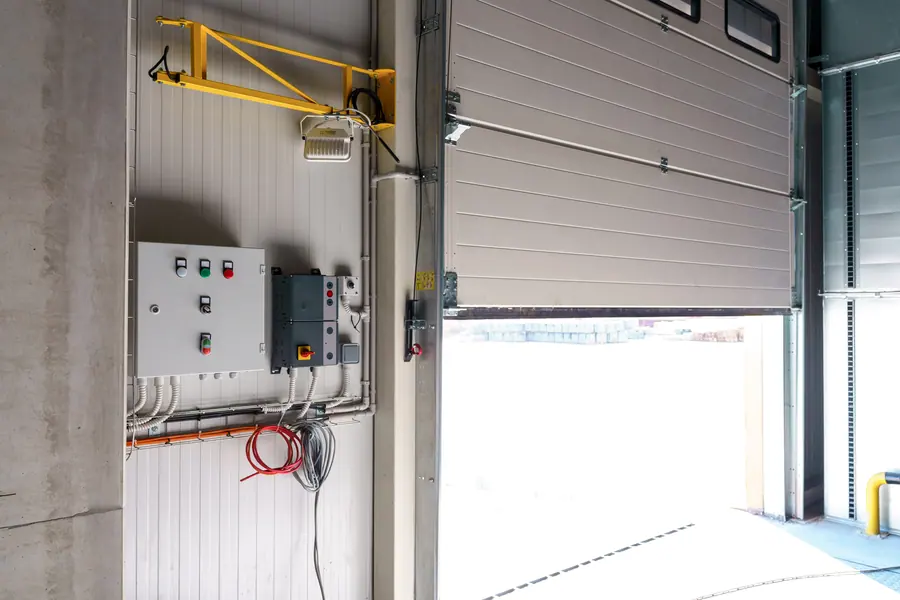
A corroded drive mechanism compared with an operator and clean controls
The "before" image shows a drive gear and cable drum on old equipment, thick with rust. The gear teeth are pitted, the cable is corroded and there's no sign of lubricant. Mechanical parts in this state bind, slip and wear rapidly, and they place a heavy load on whatever is driving them. On a door operator the equivalent is a dry chain, a worn reducer or a seized brake.
The work illustrated is an operator repair: worn drive components replaced, the brake and clutch set, limits adjusted, and controls and safety devices tested.
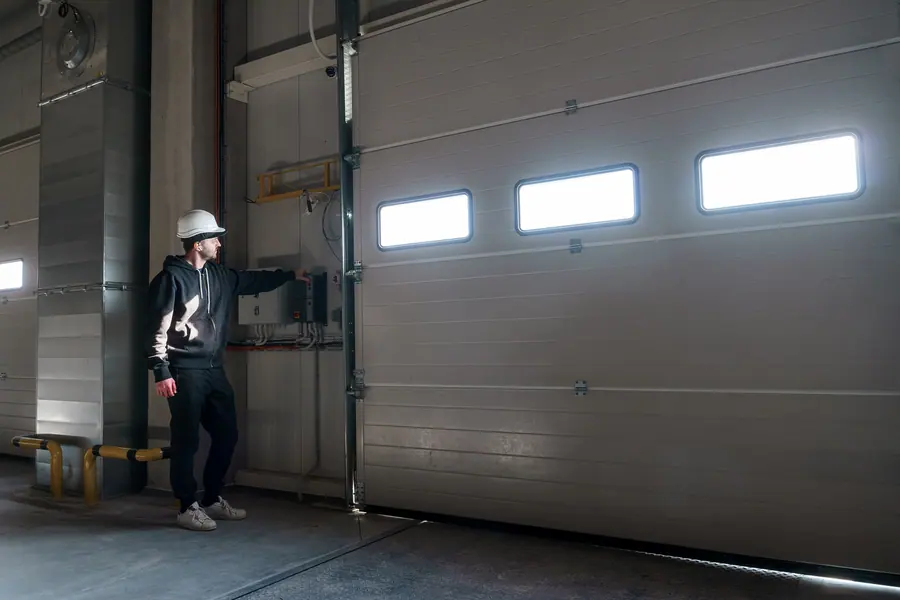
The "after" image shows a sectional door with its operator and a wall-mounted control panel, wiring routed neatly in conduit. It represents an opening that's back in dependable service. For the people who use it, that means a door that starts, stops and holds where it should, closes on one press because its safety devices are healthy, and doesn't keep the maintenance team guessing.
Illustrative exampleThese two photographs are licensed reference images chosen to show the kind of change this service makes. They are not a record of one specific Delafield Garage Door job.
Operators and the Wisconsin climate
Commercial operators often sit in unheated or semi-heated spaces, and the seasons show.
Cold starts. Gear oil thickens and motors draw more current on a January morning. An operator near the edge of its rating may trip its overload. Correct lubricant grade and a balanced door prevent it.
Condensation. Warm air from inside meets cold steel at the door. Moisture forms in limit-switch housings, control stations and junction boxes, corroding contacts and causing intermittent faults. Sealed enclosures and drip loops in wiring help.
Frozen doors. A commercial operator has enough torque to tear a frozen bottom seal or bend a section. A properly set clutch slips instead. We check that adjustment.
Sensing edges. Pneumatic edges can stiffen in deep cold; electric edges are more consistent. Coil cords become brittle with age and cold and are a frequent failure.
Photo-eyes. Snow, ice, road spray and low sun all interfere. Shielded, heated or better-positioned sensors solve persistent problems.
Power quality. Storms bring outages, surges and, on three-phase services, single-phasing. Surge protection and phase monitoring protect motors and boards.
Outages. A hoist operator's hand chain or a manual release lets you run the door without power. Staff should know where it is and how to use it.
Salt and wash bays. Corrosive environments call for sealed or stainless components.
Why operator repair is specialist work
Commercial operators run on 115, 230 or 460 volts, single- or three-phase. Working inside one is electrical work on live industrial equipment, and it requires lockout, the right test gear and training.
The mechanical side carries its own hazards. A brake released at the wrong moment lets a heavy door move. A clutch set too tight removes the protection against a jam.
There's also the compliance aspect. In a workplace, the door's safety devices are part of your responsibility to employees and visitors. A proper repair restores and verifies them.
Operator questions
Why will our door only close if we hold the button?
The operator isn't detecting a working safety device — photo-eyes or a sensing edge — so it has dropped to constant-pressure closing. The device or its wiring needs repair.
Can you repair any make of operator?
We service most common commercial brands. Send us the nameplate details and we'll confirm parts availability.
How long do commercial operators last?
With maintenance and a balanced door, many run for fifteen to twenty years or more. Under-rated units or neglected doors shorten that considerably.
Our operator keeps tripping its overload. Why?
The door may be out of balance or binding, making the motor work too hard. It can also indicate a failing motor or a supply problem. We check the door first.
Can remotes or access control be added to an existing operator?
Usually. Radio receivers, keypads, card readers and timers can be added to most operators, along with the safety devices they require.
What happens in a power outage?
Depending on the operator, there's a hand chain, a release for manual lifting, or optional battery backup. We'll show your staff how yours works.